
Toward a Persian Modernism
In the 1960s, a group of Iranian artists turned the folk objects of street shrines and talismans into modern art. Their question is still ours: how does a tradition become contemporary without becoming a costume?
A house for Persian and Iranian culture: essays and discourse, poetry in the original beside English, an atlas of the Iranian world, and original prints from our studio.

An ancient ceremonial city and a twentieth-century German art school have nothing in common but everything that matters.

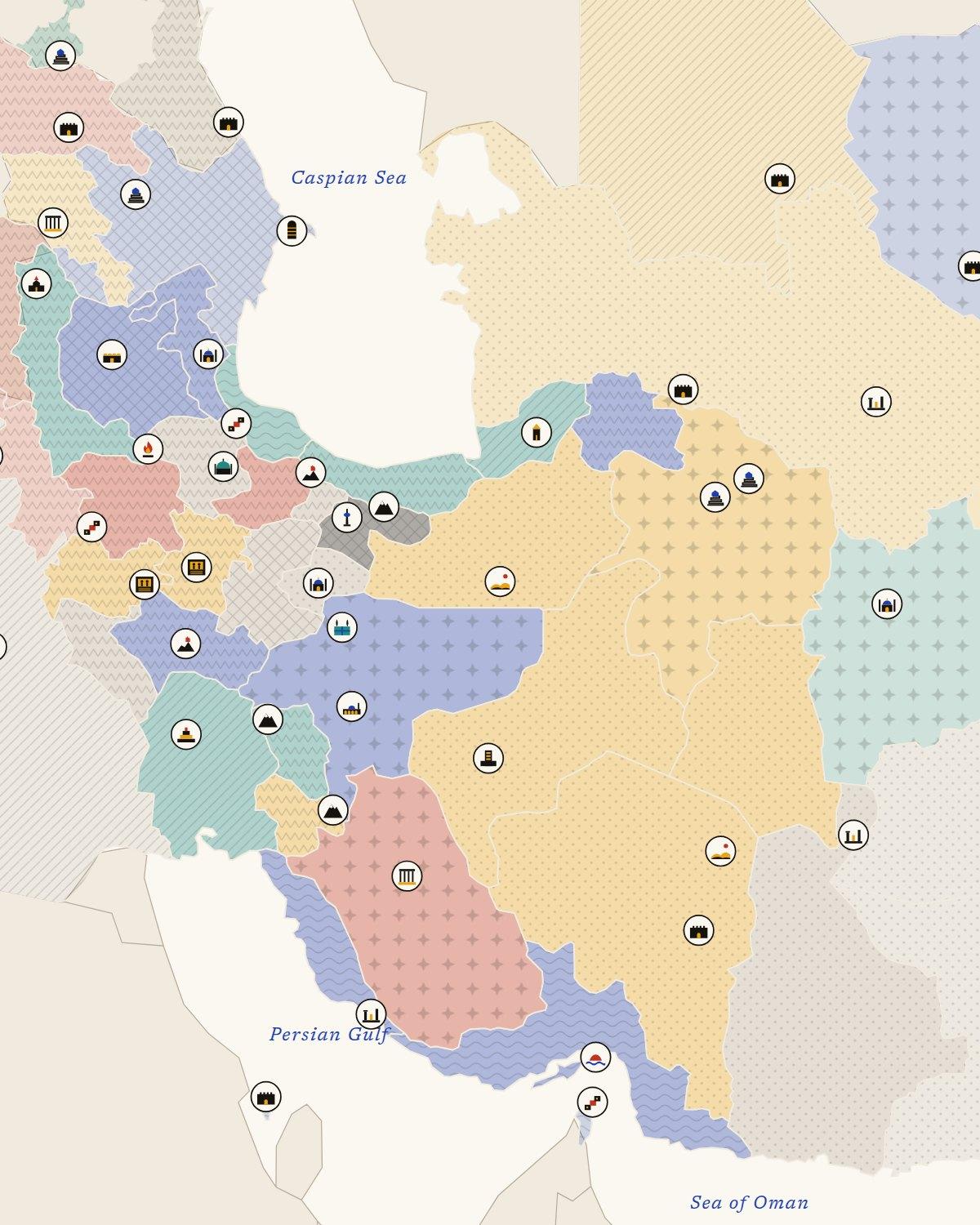
Explore Iran province by province, and the lands from the Caucasus to the Hindu Kush where Persian and its sister languages have lived for centuries.
The classical masters of Persian verse, with their poems in the original beside an English translation.

Original prints from Persiahaus Studio: the mihrab, the pomegranate and the garden in the flat colour and strict geometry of modernism.

Essays, discourse and dispatches on Persian and Iranian culture. Issue 1 asks what a homeland looks like when you carry it in forms rather than in nostalgia.
All essaysIn the 1960s, a group of Iranian artists turned the folk objects of street shrines and talismans into modern art. Their question is still ours: how does a tradition become contemporary without becoming a costume?
On Yalda, Iranians everywhere stay up through the darkest night of the year with pomegranates, watermelon and a book of Hafez. A dispatch on what ritual becomes when it travels.
The fourfold Persian garden gave the world its word for paradise. It also gave it a theory of order, built from walls, water and shade.
Homelandمیهن
Every diaspora inherits two questions: what did we bring, and what will we make of it? Our first issue answers neither neatly. Instead it walks through a palace, a poem, a garden, a winter night and a studio, and asks what a homeland looks like when you build it out of form rather than nostalgia.
Inside the issue →
Persian verse in the original, beside an English translation, from the classical Greats to contemporary poets.
The poetry roomهست وادی طلب آغاز کار
وادی عشق است از آن پس، بی کنار
پس سیم وادیست آن معرفت
پس چهارم وادی استغنی صفت
هست پنجم وادی توحید پاک
پس ششم وادی حیرت صعب ناک
هفتمین وادی فقرست و فنا
بعد ازین روی روش نبود ترا
The valley of Seeking is the beginning of the work;
after it comes the valley of Love, which has no shore;
the third valley is that of Knowledge;
fourth is the valley whose quality is Detachment;
fifth is the valley of pure Unity;
then sixth, the valley of Bewilderment, hard and perilous;
the seventh valley is Poverty and Annihilation:
beyond this you will have no way of going on.
The classical masters of Persian verse, from Ferdowsi in the tenth century to Hafez in the fourteenth.
Meet the poets
The poet of the Shahnameh, the national epic of Iran, credited with keeping the Persian language and its old stories alive.

Mathematician and astronomer of Nishapur, known to the world for quatrains on time, wine and doubt.

The master of the Persian verse romance, whose Khamsa gave the world Layli and Majnun and Khosrow and Shirin.

Druggist of Nishapur and author of The Conference of the Birds, the great allegory of the soul's journey.

Jalal al-Din, called Mowlana in Iran, the mystic poet of Konya and one of the most read poets in any language.

The moralist of Shiraz, whose Golestan has taught Persian prose to every generation since.
The supreme master of the ghazal, whose Divan is found in nearly every Iranian home.
Iran province by province, and the wider Iranian world: the history of each region, the real places of the Shahnameh, its cities and its landmarks.
Open the mapOriginal prints from Persiahaus Studio: Persian forms, from the mihrab to the pomegranate, in the flat colour and strict geometry of modernism. Printed to order, shipped worldwide.
Shop all printsPersiahaus is an editorial culture house for Persian and Iranian culture: essays and discourse, classical poetry in the original and in translation, and original prints from our studio. For the diaspora and for the curious, in English, with the Persian kept close.
About Persiahaus


