Kurds
کردهاKurds live across the Zagros and Taurus in Iran, Iraq, Turkey and Syria. In Iran they speak several Kurdish languages, keep several faiths, and light Newroz fires that every Iranian knows.

The Kurds, Kurd in their own speech, are one of the oldest peoples of the Iranian world and one of the largest without a state of their own. Their homeland, Kurdistan, runs along the Zagros and into the Anatolian highlands and is divided today between Iran, Iraq, Turkey and Syria. In Iran it covers Kurdistan province and much of Kermanshah, Ilam and West Azerbaijan; a second Kurdish world lies far to the east in North Khorasan, where Kurds were settled by the Safavids in the sixteenth and seventeenth centuries to guard the frontier.
Languages and faiths
Kurdish is a family of north-western Iranian languages rather than a single tongue. Kurmanji is spoken in the north, around Urmia and in Khorasan; Sorani around Mahabad, Sanandaj and in Iraqi Kurdistan; Southern Kurdish, including Kalhori and Feyli, around Kermanshah and Ilam. Hawrami (Gorani), the old literary language of the Ardalan court, survives in the high valleys of Hawraman, whose terraced villages became a UNESCO World Heritage site in 2021. Most Kurds of Iran are Sunni Muslims of the Shafi’i school, but Kermanshah and Ilam are largely Shia, and the Yarsan (Ahl-e Haqq) faith, with its sacred music on the tanbur, is rooted in Kurdish country. The Faiths section tells their story.
What is kept
Newroz, the Kurdish new year, is the great day: fires on hillsides, the circle dance (halparke in Sorani, govend in Kurmanji) with linked little fingers and a leader swinging a handkerchief, and the story of Kawa the blacksmith, who overthrew the tyrant Zahhak, told as a Kurdish story as well as a Persian one. The dengbêj sings long histories unaccompanied; the daf frame drum is used in Sufi gatherings from Sanandaj to Sulaymaniyah. Kurdish weavers of Senneh, Bijar and the Kurdish villages are among the great names of Persian carpet history, and Kurdish dress, men’s wide trousers and sash, women’s layered and sequinned gowns, is worn with pride on feast days. Kurdish literature includes the poets Nalî and Mawlawi in the nineteenth century and Mastoureh Ardalan (1805–1848), poet and historian of the Ardalan principality, one of the few women of her time to write a history. In the twentieth century Hejar and Hêmin, both from Mukriyan around Mahabad, wrote in Kurdish and translated between Kurdish and Persian.
What links them to Iran is old and deep: a shared language family, Newroz, and centuries of poetry and carpets that belong to both.
History, plainly
The Ardalan dynasty ruled from Sanandaj as semi-autonomous lords until the nineteenth century. In 1946 a short-lived Kurdish republic was declared at Mahabad; it fell within the year, and its president, Qazi Muhammad, was hanged in 1947. Since then Kurdish political movements and the Iranian state have clashed repeatedly. Amnesty International and successive UN Special Rapporteurs on Iran have reported that Kurds are disproportionately represented among political prisoners and among those executed on security charges. In September 2022 the death in custody of Jina Mahsa Amini, a young Kurdish woman from Saqqez, set off nationwide protests under the Kurdish-born slogan Jin, Jiyan, Azadî (‘Woman, Life, Freedom’); the UN’s independent fact-finding mission reported that the crackdown fell especially heavily on Kurdish areas.
Across the borders, Kurds in Iraq, Turkey and Syria have their own histories and institutions, and define themselves. What links them to Iran is old and deep: a shared language family, Newroz, and centuries of poetry and carpets that belong to both.
Across Cultureپیوندها
Languages
Kurdish
Spoken across the mountains where Iran, Iraq, Turkey and Syria meet, and far beyond, Kurdish is a family of closely related varieties with its own literature, written in more than one alphabet.
Faiths
Yarsan (Ahl-e Haqq)
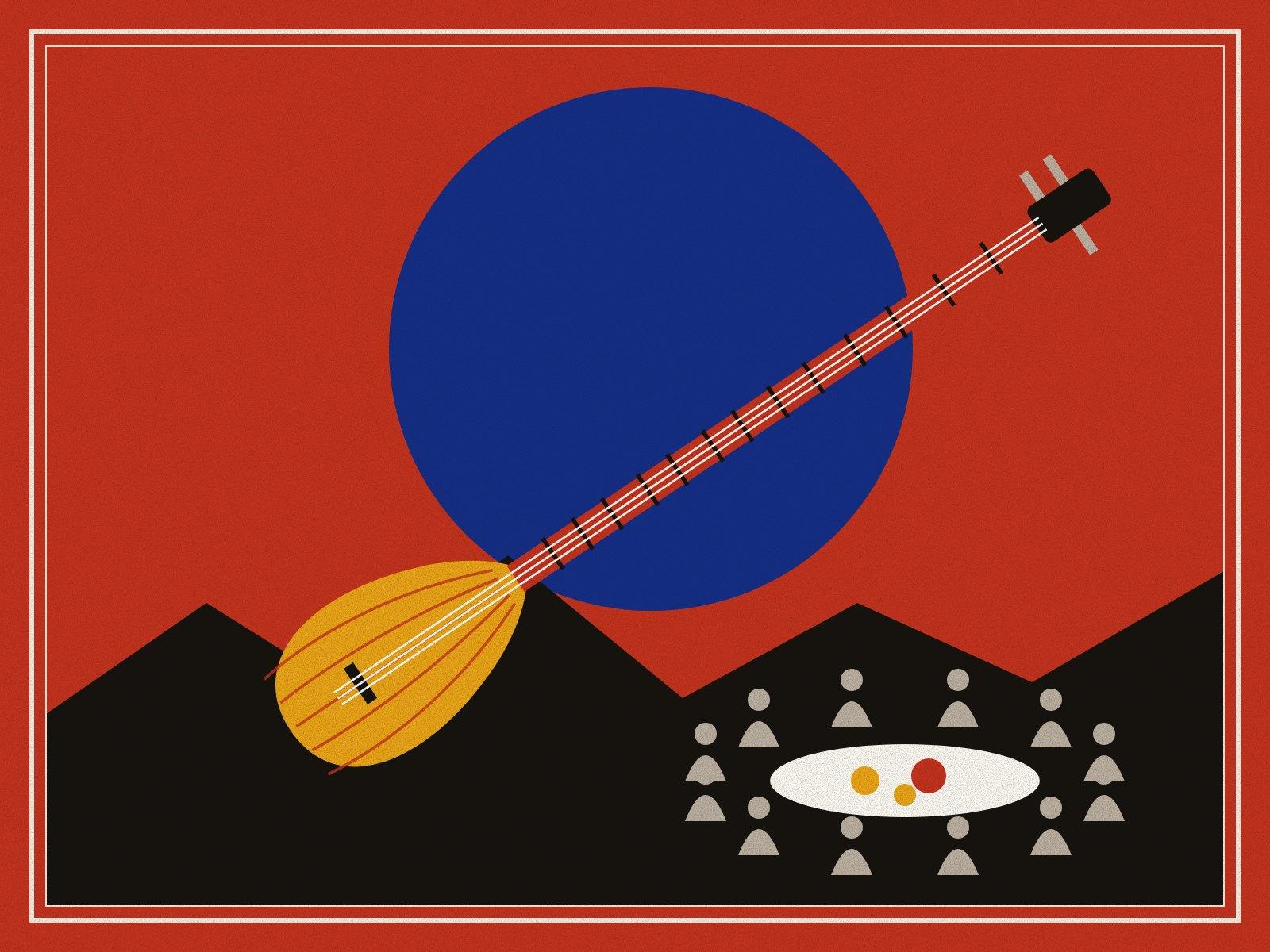
In the mountains of Kermanshah and Iraqi Kurdistan, the Yarsan keep a faith of divine manifestation, sacred music and gatherings around the long-necked tanbur.

Faiths
Sunni Islam in the Iranian world
Sunni Islam is the faith of most Muslims in Afghanistan and Tajikistan, of Kurds, Baluch and Turkmen in Iran, and of the great scholars of medieval Khorasan.
Music
Kurdish song
From the unaccompanied storytelling song of the *dengbêj* to the ancient Hawrami *siyachamana*, Kurdish song carries history, love and lament across four countries.
Music
Tanbur
A long-necked lute with two or three strings, the Kurdish tanbur carries the sacred music of the Yarsan, the People of Truth, in the mountains between Kermanshah and Iraqi Kurdistan.
Music
Tombak and daf
The goblet-shaped tombak gives Persian classical music its pulse; the great frame drum, the daf, beats at the heart of Kurdish Sufi ceremony and, since the late twentieth century, on concert stages.
More from Peoplesمردمان
Persians
Persian speakers of Iran call themselves *Fars* or simply *Irani*. They are one people among many in Iran, and their language became a shared tongue for far more than themselves.
Azerbaijanis
Iran’s Azerbaijanis, who often call themselves *Türk*, speak a Turkic language in a land named after an Iranian satrap. North of the Aras, the Republic of Azerbaijan is a separate nation that defines itself.
Lurs
Lurs speak Luri, a close cousin of Persian, in the valleys of Lorestan, Kohgiluyeh and the southern Zagros. Their country holds the Luristan bronzes, black tents and the old seasonal migration.