Azerbaijanis
آذربایجانیهاIran’s Azerbaijanis, who often call themselves *Türk*, speak a Turkic language in a land named after an Iranian satrap. North of the Aras, the Republic of Azerbaijan is a separate nation that defines itself.
In Tabriz, Ardabil, Urmia and Zanjan, and in whole districts of Tehran, the language of the street is Azerbaijani, a Turkic language of the Oghuz family, close to Turkish and Turkmen. Its speakers in Iran call themselves Azərbaycanlı, or more often simply Türk; Persian speakers say Āzari or Tork. They are one of the largest peoples of Iran and among the most woven into its national life: merchants, clerics, generals, poets and revolutionaries have come from Azerbaijan in every modern century.
A name older than the language
The province is far older than its Turkic speech. After Alexander’s conquest a Persian satrap named Atropates held north-western Media, which became known as Media Atropatene; through Middle Persian the name became Ādurbādagān and in Arabic Ādharbayjān. Its people once spoke an Iranian language, usually called Old Azari, of which only fragments survive. From the eleventh century Turkic-speaking groups arrived with the Seljuks and their successors, and over several centuries Turkic became the language of the region while much of the older culture carried on in a new tongue. The Safavid dynasty rose from a Sufi order at Ardabil, where the shrine of Sheikh Safi al-Din is now a UNESCO World Heritage site, as is the great covered bazaar of Tabriz. Shah Ismail I, who founded the dynasty in 1501, wrote poetry in Azerbaijani under the pen name Khata’i. Three centuries later, during the Constitutional Revolution, Tabriz held out against royal siege in 1908 and 1909 under Sattar Khan and Baqer Khan, a chapter still honoured across Iran.
Two shores of the Aras
After wars with Russia, the treaties of Gulistan (1813) and Turkmenchay (1828) left the khanates north of the Aras river in the Russian Empire. That land declared an independent Azerbaijan Democratic Republic in 1918, became a Soviet republic, and since 1991 has been the independent Republic of Azerbaijan, a nation with its own capital in Baku, its own state and its own account of its history. Families, songs and dishes cross the river; sovereignty does not. Persiahaus treats the two as kin, not as one.
What is kept
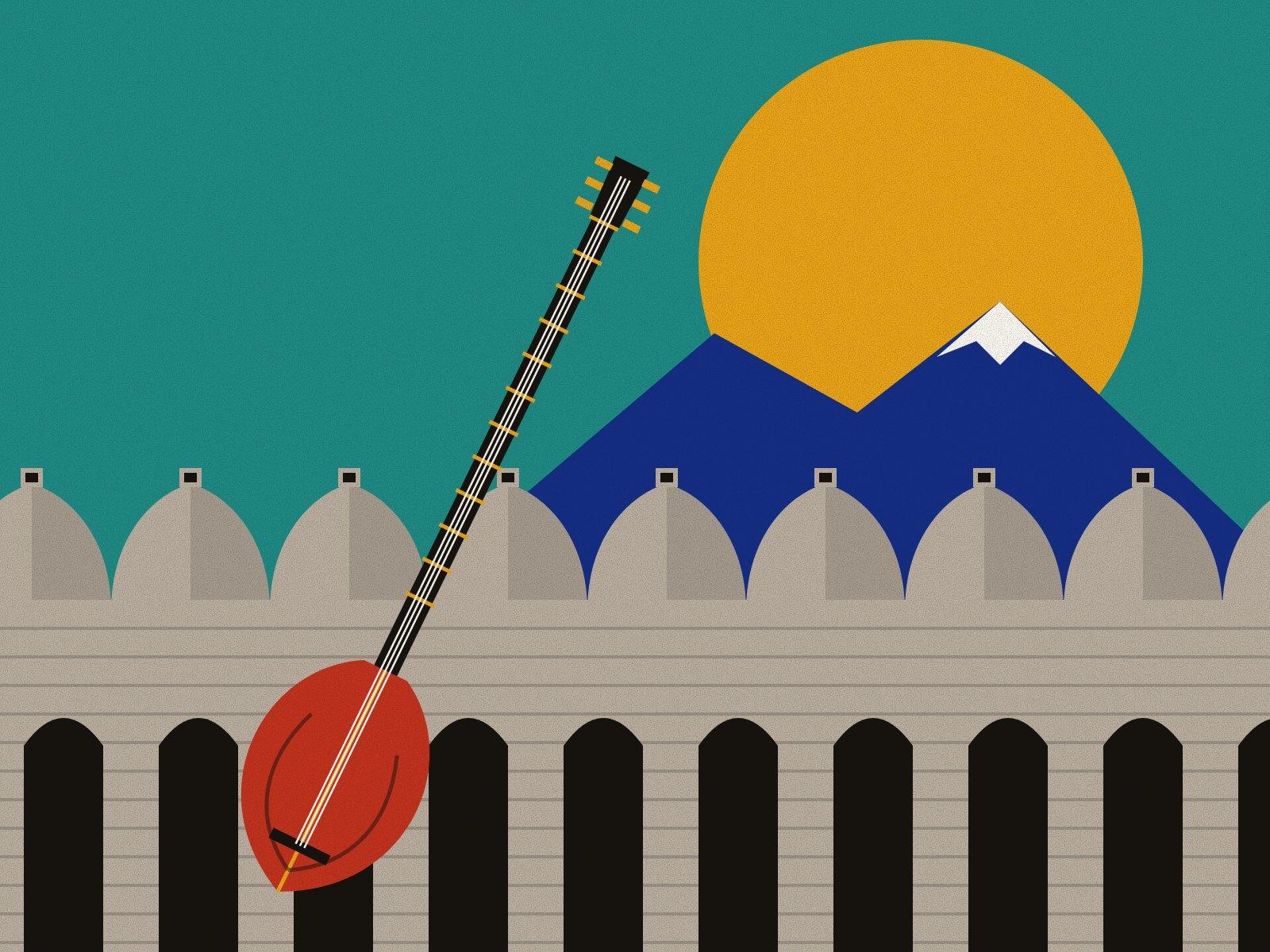
The ashiq, a minstrel who sings long romances and contests to the long-necked saz, is the emblem of Azerbaijani music on both sides of the river; so are the modal art of mugham and the epic of Köroğlu. The best-loved modern poem is Mohammad-Hossein Shahriar’s Heydar Babaya Salam (‘Greetings to Heydar Baba’), a memory of village childhood near Tabriz written in Azerbaijani by a poet equally celebrated in Persian. Kitchens give the rest of Iran kufteh Tabrizi and the sweet qurabiyeh, and Tabriz carpets are among the most famous of all city rugs.
Families, songs and dishes cross the river; sovereignty does not.
Iran’s constitution makes Persian the official language while allowing regional languages in the press and in the teaching of their literature (Article 15). Minority Rights Group International and UN human rights reporting have documented that schooling in Azerbaijani remains very limited and that activists campaigning for mother-tongue education have been arrested. For most Azerbaijanis in Iran, meanwhile, being Türk and being Iranian are not alternatives but two halves of one life.
Across Cultureپیوندها

Languages
Azerbaijani Turkish
The mother tongue of millions in north-western Iran and the official language of the Republic of Azerbaijan, Azerbaijani Turkish is a Turkic language with a deep Persian inheritance and a poetry all its own.
Music
The ashiq and the saz
Poet, singer, storyteller and player of the long-necked saz, the *ashiq* is the minstrel of the Azerbaijani-speaking world, on both banks of the Aras.
Music
Kamancheh
A small round bowl, a long neck and a spike to rest on the knee: the kamancheh is the bowed voice of Persian music, turned rather than bowed across.
Music
Tar
With its double-bowled mulberry body and skin face, the tar was the instrument on which the radif itself was codified. In the Caucasus a related tar has grown into a tradition of its own.
More from Peoplesمردمان
Persians
Persian speakers of Iran call themselves *Fars* or simply *Irani*. They are one people among many in Iran, and their language became a shared tongue for far more than themselves.

Kurds
Kurds live across the Zagros and Taurus in Iran, Iraq, Turkey and Syria. In Iran they speak several Kurdish languages, keep several faiths, and light Newroz fires that every Iranian knows.
Lurs
Lurs speak Luri, a close cousin of Persian, in the valleys of Lorestan, Kohgiluyeh and the southern Zagros. Their country holds the Luristan bronzes, black tents and the old seasonal migration.