Yarsan (Ahl-e Haqq)
یارسان (اهل حق)In the mountains of Kermanshah and Iraqi Kurdistan, the Yarsan keep a faith of divine manifestation, sacred music and gatherings around the long-necked tanbur.
The Yarsan call themselves Yarsan or Yaresan, ‘the community of friends’, and are also known as Ahl-e Haqq, ‘People of the Truth’; in Iraq they are often called Kaka’i. Most are Kurds, especially Gurani-speaking Kurds of Kermanshah province, with communities among Lurs, Laks, Azerbaijanis and Persians. They live around Gahvareh, Kerend and Sahneh, in the Dalahu mountains, in Tehran and across the border near Kirkuk, Halabja and the Nineveh plain.
Their faith took its present form with Sultan Sahak, a teacher of the fourteenth or fifteenth century who lived at Perdiwar in Hawraman, on the banks of the Sirwan river. Yarsan believe that the divine essence has manifested itself in human form in a series of eras, and that each manifestation was accompanied by angelic companions, the Haft Tan, the Seven. They also hold that the soul passes through a succession of bodies, ‘garments’ (dun), before reaching purity. Sacred texts, collectively called Kalam, are verses, most of them in Gurani, among them the Kalam-e Saranjam.
The jam and the tanbur
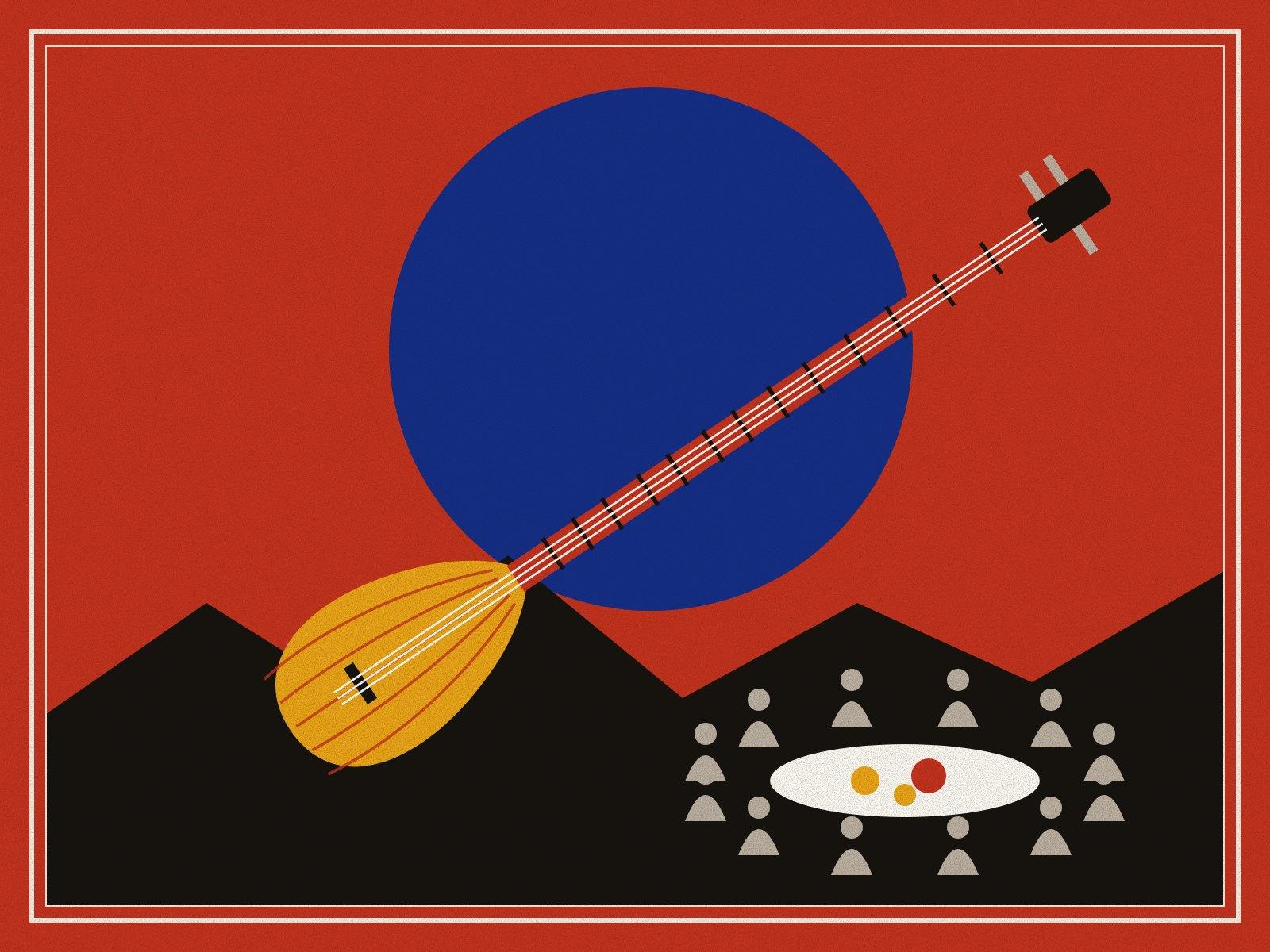
The centre of Yarsan religious life is the jam, a gathering of believers seated in a circle, where prayers are said, Kalam are sung to the tanbur, and a vowed offering, nazr or niyaz, is blessed and shared. The tanbur, a long-necked lute, is a sacred instrument. Yarsan musicians such as Ostad Elahi and Ali Akbar Moradi of Gahvareh have also brought its music to concert halls around the world. Each believer is tied to one of the hereditary khandan, lineages of spiritual guides, through a pir and a dalil. Many Yarsan men keep a long, untrimmed moustache as a sign of faith. A three-day winter fast is followed by a feast.
The tanbur, a long-necked lute, is a sacred instrument.
Sultan Sahak’s teaching is often summed up in four duties: purity, paki; truthfulness, rasti; self-effacement, nisti; and generosity, reda. The Kalam belong to a wider tradition of poetry in Gurani, once the literary language of much of western Kurdistan, and Yarsan regard their poet-saints, among them Sheikh Amir and Khan Almas, as voices of the truth in their own ages. Verses are learned by heart, sung from father to son and, increasingly, written down and printed.
Pilgrims visit Perdiwar and the shrine of Baba Yadegar in the mountains near Sarpol-e Zahab, a green valley that fills with families, tents and music. Yarsan describe their relationship to Islam in different ways: some see their faith as a form of Shia mysticism, others as an independent religion with its own revelation.
Recognition
Yarsan are not recognised as a separate religion under Iran’s constitution, and many say this leaves them without protection. Minority Rights Group and the UN Special Rapporteur on the situation of human rights in Iran have reported discrimination in employment and education and pressure over the moustache and other signs of faith. In Iraq, Kaka’i communities were among those targeted by ISIS. Yet the faith is also flourishing in new ways, as young Yarsan in Kermanshah, Erbil and Europe learn the Kalam and the tanbur.
Across Cultureپیوندها
Music
Tanbur
A long-necked lute with two or three strings, the Kurdish tanbur carries the sacred music of the Yarsan, the People of Truth, in the mountains between Kermanshah and Iraqi Kurdistan.

Peoples
Kurds
Kurds live across the Zagros and Taurus in Iran, Iraq, Turkey and Syria. In Iran they speak several Kurdish languages, keep several faiths, and light Newroz fires that every Iranian knows.
More from Faithsدینها
Zoroastrianism
Good thoughts, good words, good deeds: the faith of Zarathushtra, kept by its followers in Yazd, Kerman, Tehran, Mumbai and far beyond.

Mithra and the old Iranian gods
Before and beside Zarathushtra stood older Iranian divinities: Mithra of the covenant, Anahita of the waters, Verethragna of victory. Their names survive in hymns, festivals and children.

Manichaeism
Mani, born in Sasanian Mesopotamia in 216 CE, founded a faith of light and darkness that reached from Roman Africa to the coast of China, and left Persian a proverbial painter.