Tanbur
تنبورA long-necked lute with two or three strings, the Kurdish tanbur carries the sacred music of the Yarsan, the People of Truth, in the mountains between Kermanshah and Iraqi Kurdistan.
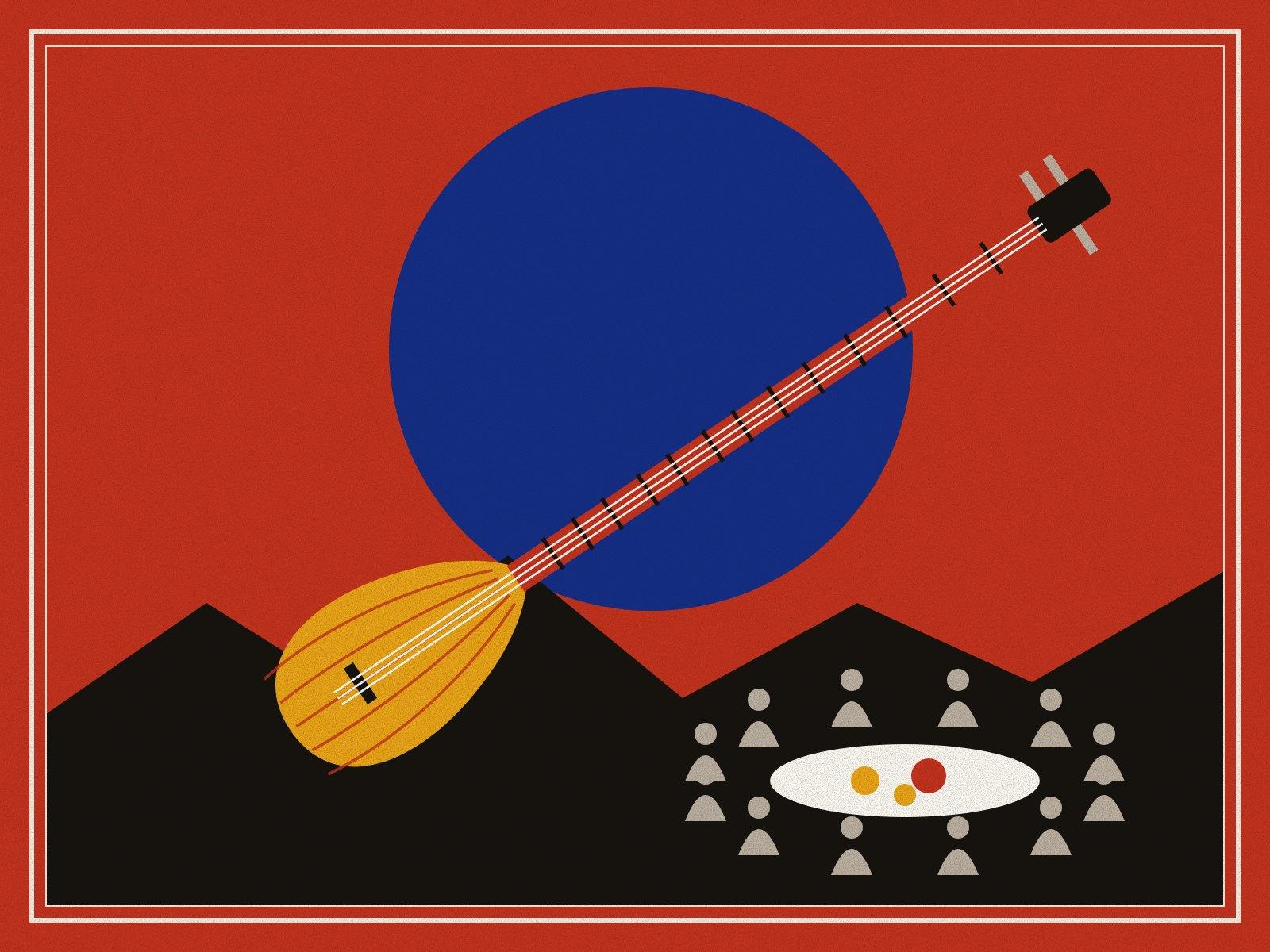
The tanbur is a long-necked lute with a pear-shaped body carved from a single piece of mulberry and a thin wooden face. It has two or three metal strings, tied frets and a slender neck, and it is played with the fingers of the right hand in a fluid strumming technique called shor, in which all the fingers sweep and flick the strings. Its tone is dry, close and rippling. Long-necked lutes of the same name are played across a vast area, from Turkey to Central Asia, but the tanbur of the Kurds has a particular home and a particular meaning.
The music of the Yarsan
For the Yarsan, also called the Ahl-e Haqq, ‘People of Truth’, the tanbur is a sacred instrument. The Yarsan are a faith community with roots in the Gorani-speaking regions of Kermanshah, around Sahneh, Gahvareh, Kerend and the Dalahu range, and in neighbouring Iraqi Kurdistan, where related communities are known as the Kaka’i. Their sacred texts, the kalam, are poems in Gorani attributed to Sultan Sahak and other holy figures, and at the communal gathering, the jam, they are sung to the tanbur. Members of the community describe these melodies, many of them called maqam, as a repertoire handed down with the scripture itself.
The tanbur is played seated, held almost horizontally, and in the jam it is often played by several people together while the gathering sings. The instrument is treated with respect, and many Yarsan homes keep one. For believers the music is part of worship, a means of remembrance and of opening the heart, not an ornament to it.
For believers the music is part of worship, a means of remembrance and of opening the heart, not an ornament to it.
From shrine to stage
In the twentieth century, players from Yarsan families brought the tanbur’s repertoire to wider audiences. Ostad Elahi (1895–1974), a jurist and thinker from a Yarsan family of Jeyhunabad, was also a master of the instrument, and his recordings showed its depth to listeners outside the community. Later musicians, among them Seyyed Khalil Alinejad (1957–2001), took it onto concert stages in Iran and Europe. The tanbur’s place in concert life is now well established, and its spiritual repertoire is studied by scholars of Kurdish and Iranian music.
Members of the Yarsan community have reported official non-recognition of their faith in Iran and pressures on its practice, which are documented in the annual reports of the US Commission on International Religious Freedom and in the work of the Minority Rights Group. The tanbur, heard far beyond Kermanshah, has become one of the best-known expressions of their heritage, and of the place of music in the religious life of the Kurdish world.
Across Cultureپیوندها
Faiths
Yarsan (Ahl-e Haqq)
In the mountains of Kermanshah and Iraqi Kurdistan, the Yarsan keep a faith of divine manifestation, sacred music and gatherings around the long-necked tanbur.

Peoples
Kurds
Kurds live across the Zagros and Taurus in Iran, Iraq, Turkey and Syria. In Iran they speak several Kurdish languages, keep several faiths, and light Newroz fires that every Iranian knows.
More from Musicموسیقی
The radif and the dastgah
Persian classical music is not written down as compositions but held in the *radif*, a body of melodies passed from master to pupil and arranged into twelve modal systems.
Avaz: the classical voice
In Persian classical music the singer is the centre, and the song is a poem: a ghazal of Hafez, Saadi or Rumi, unfolded line by line in free rhythm and ornamented with the breaking voice of the *tahrir*.
Barbad and the Sasanian court
Barbad, minstrel to Khosrow II, is the most famous musician in Persian memory. Little about him can be proved; much about him has been loved, retold and painted for fourteen centuries.