Chaharshanbe Suri
چهارشنبهسوریOn the Tuesday night before the last Wednesday of the year, Iranians light bonfires and jump over them, giving their winter pallor to the flames and taking back the fire's red. It is the first of the rites that clear the way for Nowruz.

Chaharshanbe is Wednesday, and Chaharshanbe Suri is kept on the night before the last Wednesday of the Iranian year, so on a Tuesday evening a week or so before Nowruz. The date moves each year. Suri is usually explained as 'red', from the Middle Persian word for the colour of fire, though some read it as 'festive'; in Isfahan the night has been called Chaharshanbe Sorkhi, 'Red Wednesday'. At dusk smoke rises from streets, courtyards and rooftops, children run between the fires, and the old year is sent off with noise.
Fire, spoons and omens
The heart of the night is the jump. Small bonfires are lit, often in odd numbers, one, three, five or seven, and people leap over them one after another, singing zardi-ye man az to, sorkhi-ye to az man: 'my yellowness to you, your redness to me'. The pallor and sickness of winter go into the flames; their warmth and colour come back. In many places the old earthenware pots of the house were then broken, often dropped from the roof, to carry bad luck away with them. In Tehran a coin might be put inside first; in Khorasan, salt and a piece of charcoal. Seeds of esfand, wild rue, are thrown on the coals against the evil eye.
After the fire come the visitors. In qashoq-zani, 'spoon-banging', young people wrap themselves in chadors so that no one knows them, go from door to door and tap a spoon against a bowl until the household fills it with ajil, sweets or money. Folklorists have linked the custom to the old belief that the dead come back veiled at the end of the year and must be given something. Unmarried girls practise fal-gush, 'listening for an omen': they make a wish, stand behind a wall or at a street corner, and take the first words they overhear from passers-by as the answer. Others draw fortunes from a jar of folded verses, which in Isfahan were often taken from the Divan of Hafez. In the north, young men once practised shal-andazi, lowering a sash or cloth from the roof into a household and waiting to see what gift would be tied to it.
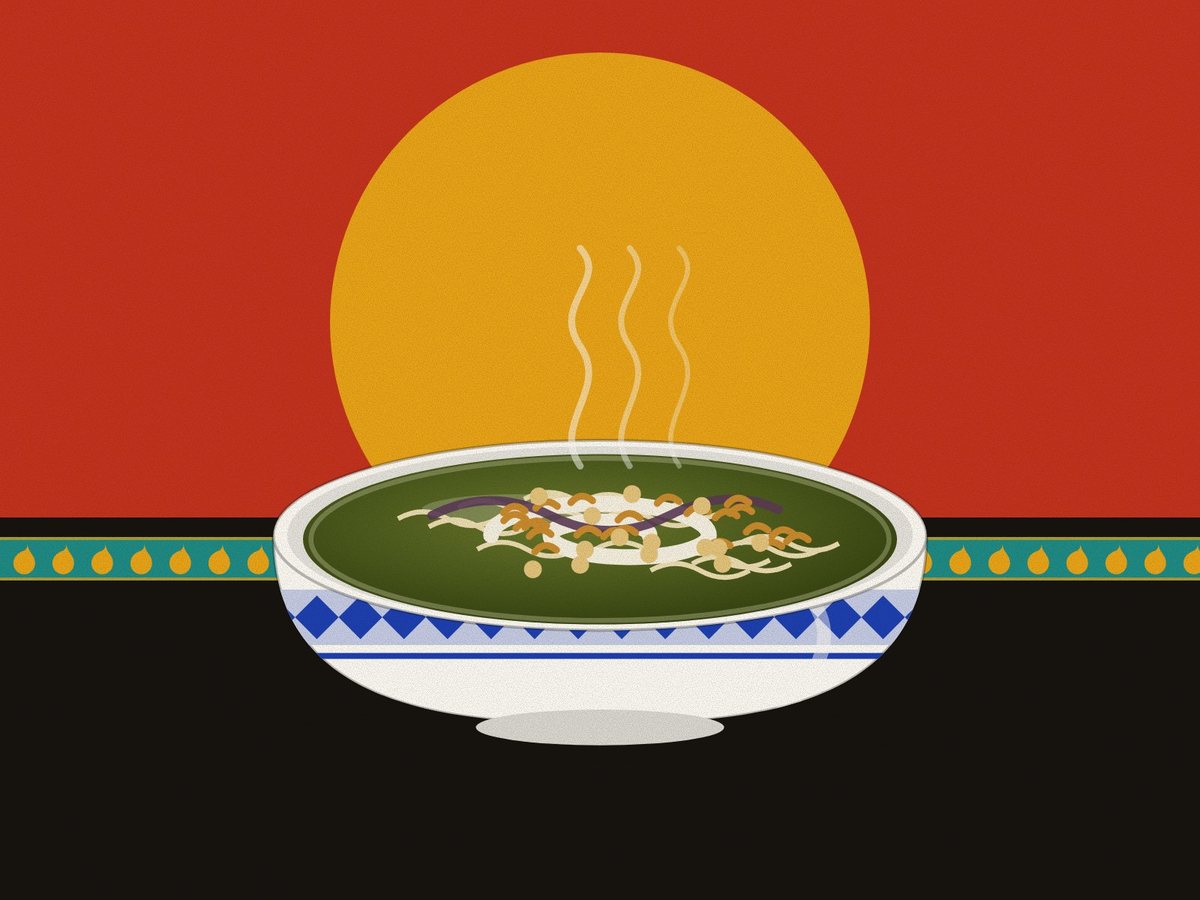
The night has its own ajil, a sweet and salty mix of pistachios, almonds, roasted chickpeas and raisins, said to help wishes come true. Many families also share out ajil-e moshkel-gosha, 'the nuts that untie difficulties', a mixture vowed and handed round when a wish is made or granted. It is kept at other times of year as well, but this night is a favourite occasion for it. Supper varies by city: herbed rice with fish in Tehran and the north, rice with ash-e reshteh, noodle soup, in Kerman and Shiraz, where the long noodles promise a long life.
Old roots, argued over
The festival is clearly old, but its history is disputed. Ebrahim Pourdavoud and others connected it with the last days of the Zoroastrian year, Hamaspathmaedaya, later called Farvardigan, when the fravashis, the guardian spirits of the dead, were believed to return to their homes and fires were lit to welcome them. The researcher Katayoun Mazdapour argued that its fire rites may be older than Zoroastrianism itself. The Wednesday, however, cannot be ancient, since the old Iranian calendar named every day of the month and had no seven-day week. Some scholars therefore date the present form to the Islamic period, and Pourdavoud suggested that Wednesday was chosen because it came to be seen as an unlucky day. A tenth-century history of Bukhara already mentions the lighting of fires on the 'suri night' as an old custom.
In the Islamic Republic the festival has been officially discouraged. Senior clerics, including Ayatollah Khamenei in 1999, have criticised it as un-Islamic, some have declared fireworks forbidden, and each year the police warn against gatherings. It is kept all the same, and in some years it has become a moment of protest. It has also grown louder and more dangerous. Homemade firecrackers and explosives have partly replaced the quieter rites, and every year the emergency services report injuries, burns and sometimes deaths, while burning tyres and plastic add to the smoke over the cities.
Beyond Tehran
Customs differ widely. A study in the 1970s found that some Kurdish communities kept their fires for Nowruz rather than for this night, while other accounts describe Kurdish families lighting fires outside the house, gathering the ashes into a broken pot and throwing it into a ruin. Some Kurds keep a separate 'Black Wednesday' before Nowruz, with disguises and faces marked with charcoal. Azerbaijanis in Tabriz and Ardabil call the night Axır Çərşənbə, 'the last Wednesday'; in Tabriz children once jumped over running water in the morning, and water was thrown from the rooftops. In the Republic of Azerbaijan the four Tuesdays before Novruz are given to water, fire, wind and earth, children jump small fires on each, and on the last they leave their hats at neighbours' doors to be filled with sweets. In the diaspora, Stockholm's Eldfesten has become one of the largest gatherings, broadcast on Swedish and Persian-language television, and fires have been lit for the night from Vancouver to New York.
When it fallsکی
In the Persian calendar it keeps its day; in the Gregorian calendar the day moves a little from year to year.
Tuesday evening, 16 March 2027
Tuesday evening, 14 March 2028
Tuesday evening, 13 March 2029
At the tableسفره

Across Cultureپیوندها
Faiths
Zoroastrianism
Good thoughts, good words, good deeds: the faith of Zarathushtra, kept by its followers in Yazd, Kerman, Tehran, Mumbai and far beyond.

Peoples
Kurds
Kurds live across the Zagros and Taurus in Iran, Iraq, Turkey and Syria. In Iran they speak several Kurdish languages, keep several faiths, and light Newroz fires that every Iranian knows.
Peoples
Azerbaijanis
Iran’s Azerbaijanis, who often call themselves *Türk*, speak a Turkic language in a land named after an Iranian satrap. North of the Aras, the Republic of Azerbaijan is a separate nation that defines itself.
Peoples
Persians
Persian speakers of Iran call themselves *Fars* or simply *Irani*. They are one people among many in Iran, and their language became a shared tongue for far more than themselves.
More from Festivalsجشنها

Nowruz
The Persian new year, Nowruz, 'new day', begins at the moment of the March equinox. Homes are cleaned, the haft-sin is laid, and families visit one another across Iran, Afghanistan, Central Asia, the Caucasus and the diaspora.

Sizdah Bedar
On the thirteenth day of the new year, families leave their homes for parks, rivers and hillsides, throw the sabzeh from the haft-sin into running water and knot blades of grass for a wish. In Iran it is officially Nature Day.

Tirgan
A midsummer festival of water on Tir day of the month of Tir. People splash one another, tie a rainbow cord round the wrist, and remember Tishtrya, the star who brings rain, and the arrow of Arash.