Tar
تارWith its double-bowled mulberry body and skin face, the tar was the instrument on which the radif itself was codified. In the Caucasus a related tar has grown into a tradition of its own.
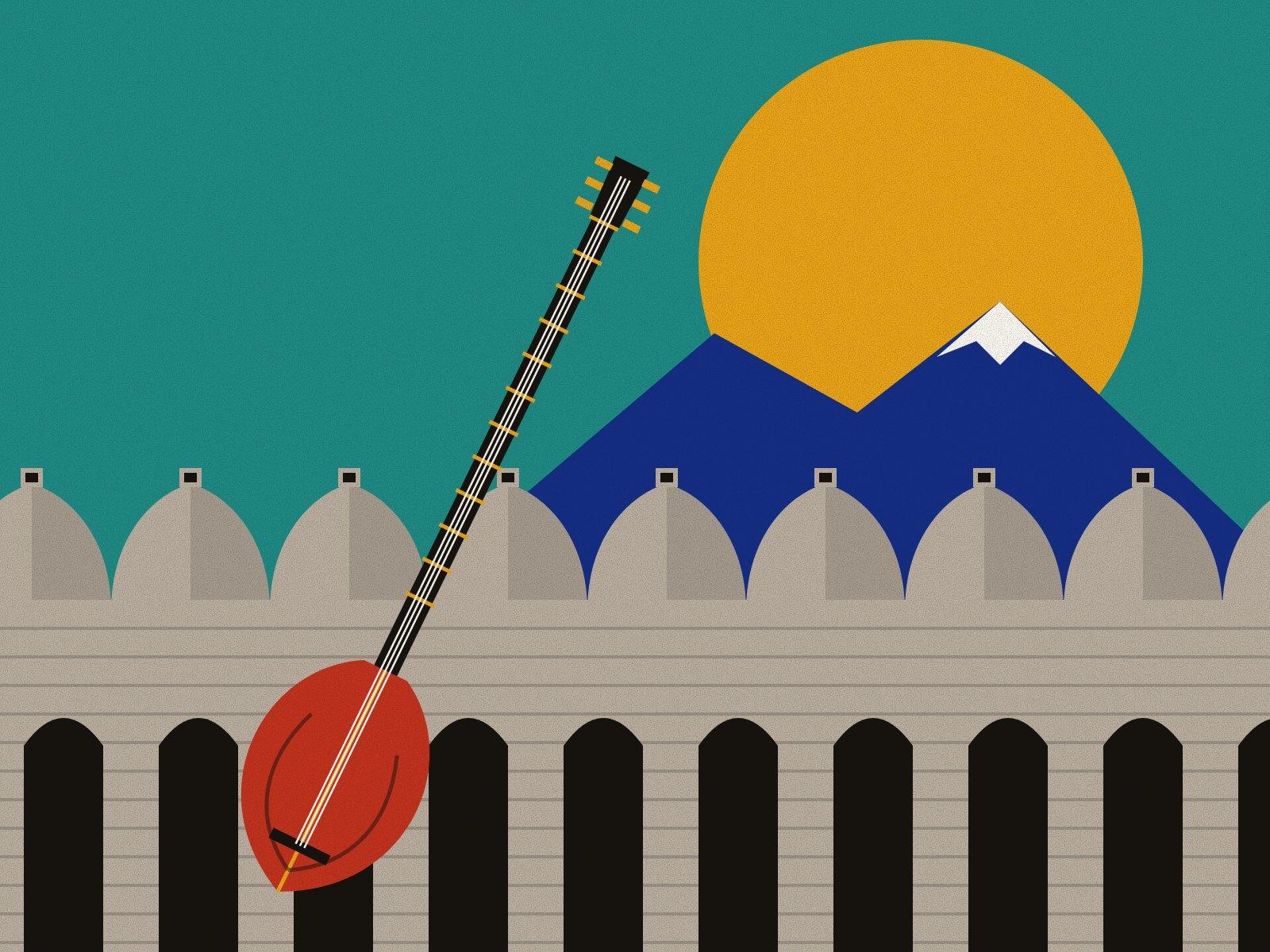
Tar means ‘string’ in Persian. The instrument is a long-necked lute whose body is carved from a single piece of mulberry wood into two bowls, a larger one below and a smaller one above, like a figure of eight seen from the side. The face is a thin membrane of lambskin, which gives the tar its bright, slightly nasal attack. The fretted neck carries gut frets tied around it, set to give the intervals of Persian music, including the notes that fall between the semitones of European tuning.
The Persian tar has six strings in three pairs, played with a small brass plectrum set in wax. It is held across the lap. Its range, its clarity and its capacity for both melody and rhythmic drive made it the leading instrument of the Qajar court, and the radif itself was organised by a family of tar players: Ali-Akbar Farahani and his sons Mirza Abdollah and Mirza Hossein-Qoli. Gholam-Hossein Darvish, known as Darvish Khan (died 1926), is credited with adding a sixth string and with composing a repertoire of metric pieces, pishdaramad and reng, that framed the improvised sections of a performance.
Its range, its clarity and its capacity for both melody and rhythmic drive made it the leading instrument of the Qajar court, and the radif itself was organised by a family of tar players: Ali-Akbar Farahani and his sons Mirza Abdollah and Mirza Hossein-Qoli.
Making a tar
Tar making is a craft centred on a handful of workshops, in Tehran, Isfahan, Shiraz and elsewhere. The maker selects seasoned mulberry, hollows the body, sets the neck of walnut, stretches the skin and fits the bone or camel-bone bridge. A good instrument is judged by the evenness of its tone across the registers and by how it answers the fine touch of the plectrum. Makers’ names circulate among players as carefully as performers’.
The tar of the Caucasus
North of the Aras the tar developed differently. In the nineteenth century Mirza Sadiq Asad oghlu, known as Sadigjan, a musician of Shusha in Karabakh, reshaped the instrument: he lightened the body, added strings, including sympathetic and drone strings, and had it held high against the chest rather than across the lap. The Azerbaijani tar became the principal instrument of mugham, the classical modal tradition of the Republic of Azerbaijan, and spread to Armenia, Georgia and Dagestan. In 2012 UNESCO inscribed the craftsmanship and performance art of the tar on the Representative List on the nomination of Azerbaijan.
Both traditions share an ancestor and a name, and musicians on either side of the border know each other’s styles. Each is also complete in itself, with its own masters, its own repertoire and its own way of holding the instrument, and each nation tells the story of the tar in its own terms.
Across Cultureپیوندها
Music
The radif and the dastgah
Persian classical music is not written down as compositions but held in the *radif*, a body of melodies passed from master to pupil and arranged into twelve modal systems.
Peoples
Azerbaijanis
Iran’s Azerbaijanis, who often call themselves *Türk*, speak a Turkic language in a land named after an Iranian satrap. North of the Aras, the Republic of Azerbaijan is a separate nation that defines itself.
More from Musicموسیقی
The radif and the dastgah
Persian classical music is not written down as compositions but held in the *radif*, a body of melodies passed from master to pupil and arranged into twelve modal systems.
Avaz: the classical voice
In Persian classical music the singer is the centre, and the song is a poem: a ghazal of Hafez, Saadi or Rumi, unfolded line by line in free rhythm and ornamented with the breaking voice of the *tahrir*.
Barbad and the Sasanian court
Barbad, minstrel to Khosrow II, is the most famous musician in Persian memory. Little about him can be proved; much about him has been loved, retold and painted for fourteen centuries.