Kamancheh
کمانچهA small round bowl, a long neck and a spike to rest on the knee: the kamancheh is the bowed voice of Persian music, turned rather than bowed across.
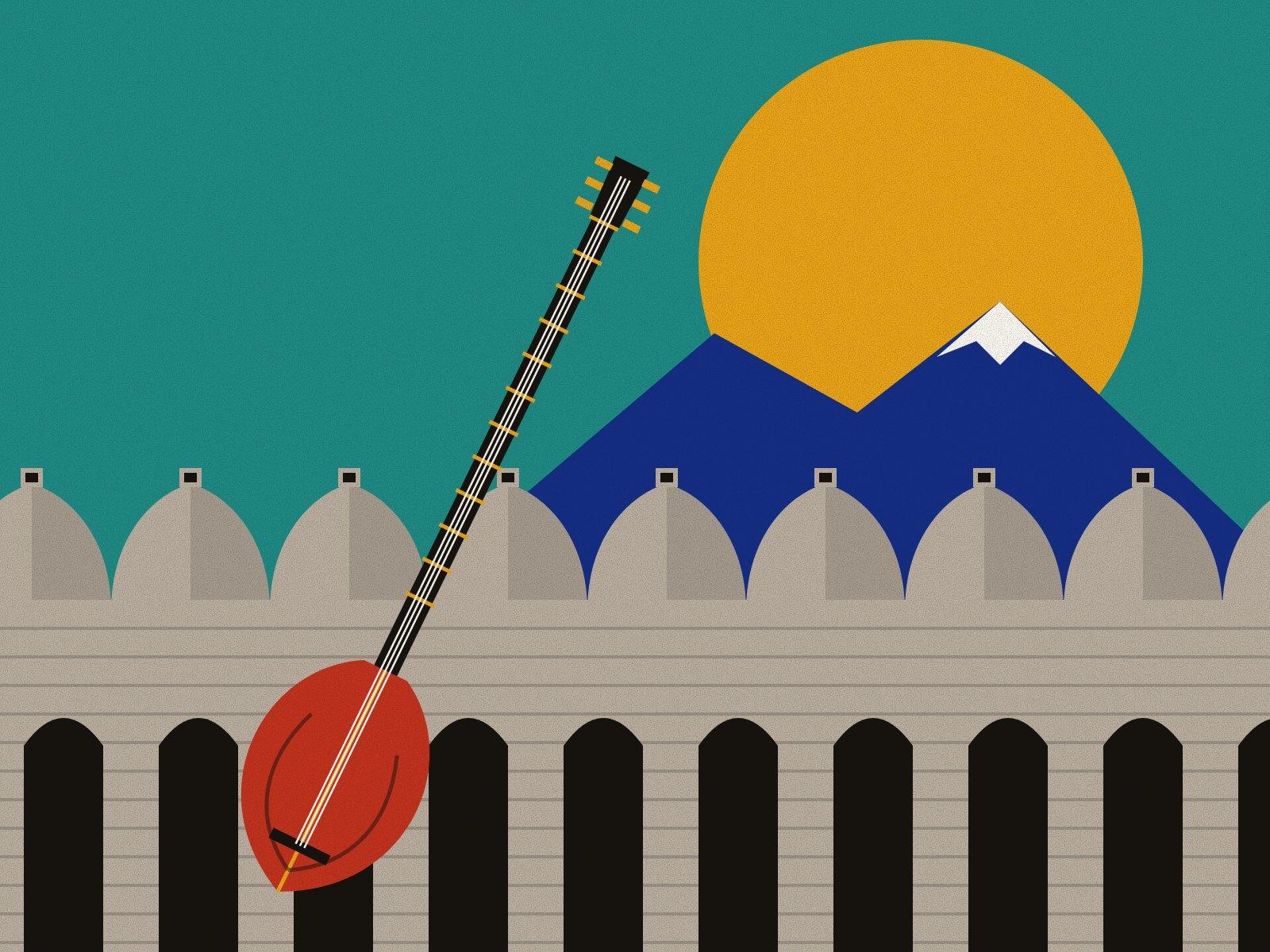
Kamancheh means ‘little bow’. It is a spike fiddle: a spherical or bowl-shaped body, usually of mulberry or walnut, covered with a thin skin membrane, a long cylindrical neck with no frets, and an iron spike projecting below, on which the instrument stands on the player’s knee or the floor. The player sits and holds it upright. Rather than moving the bow across a fixed instrument, the kamancheh player often turns the instrument itself to meet the bow, a technique that gives its playing a distinctive, rotating fluidity.
The modern kamancheh has four strings, earlier forms three. Its tone is close to the human voice, with a warm lower range and a plaintive upper one, which is why it is so often paired with singers. Because its neck is unfretted, the player can slide between pitches and shade the intervals of the modes with great subtlety.
Its tone is close to the human voice, with a warm lower range and a plaintive upper one, which is why it is so often paired with singers.
A shared instrument
Spike fiddles of this family are played across a wide area, from the Caucasus to Central Asia, and their history reaches back many centuries in Persian sources and painting. The kamancheh is at home in the classical music of Iran, in the mugham of the Republic of Azerbaijan, in Armenian music and in many regional traditions, including the music of Lorestan, of Azerbaijan in Iran, of Kurdistan and of the Turkmen. Related bowed instruments, the ghichak or ghaychak of Baluchistan, Afghanistan and Central Asia among them, carry the same idea in other shapes.
In 2017 UNESCO inscribed the art of crafting and playing the kamancheh, spelled kamantcheh or kamancha, on the Representative List of the Intangible Cultural Heritage of Humanity, in a joint nomination of Iran and the Republic of Azerbaijan. The joint file reflects what musicians already knew: the instrument belongs to more than one nation, and each plays it in its own way.
Masters
In the twentieth century the kamancheh was eclipsed for a time by the European violin, which entered Iranian music in the Qajar period and was widely adopted. Players such as Ali-Asghar Bahari (died 1995) kept the instrument alive and brought it back to prominence, and from the 1970s onward a revival among younger musicians restored it to the centre of classical ensembles in Iran. Today it is one of the most studied instruments in Iranian conservatories and private schools, and makers in Tehran and Isfahan supply instruments to players abroad. In the Republic of Azerbaijan the kamancha remains a pillar of the mugham trio, alongside the tar and the singer with his or her frame drum.
Across Cultureپیوندها
Peoples
Azerbaijanis
Iran’s Azerbaijanis, who often call themselves *Türk*, speak a Turkic language in a land named after an Iranian satrap. North of the Aras, the Republic of Azerbaijan is a separate nation that defines itself.
More from Musicموسیقی
The radif and the dastgah
Persian classical music is not written down as compositions but held in the *radif*, a body of melodies passed from master to pupil and arranged into twelve modal systems.
Avaz: the classical voice
In Persian classical music the singer is the centre, and the song is a poem: a ghazal of Hafez, Saadi or Rumi, unfolded line by line in free rhythm and ornamented with the breaking voice of the *tahrir*.
Barbad and the Sasanian court
Barbad, minstrel to Khosrow II, is the most famous musician in Persian memory. Little about him can be proved; much about him has been loved, retold and painted for fourteen centuries.