The ashiq and the saz
عاشیق و سازPoet, singer, storyteller and player of the long-necked saz, the *ashiq* is the minstrel of the Azerbaijani-speaking world, on both banks of the Aras.
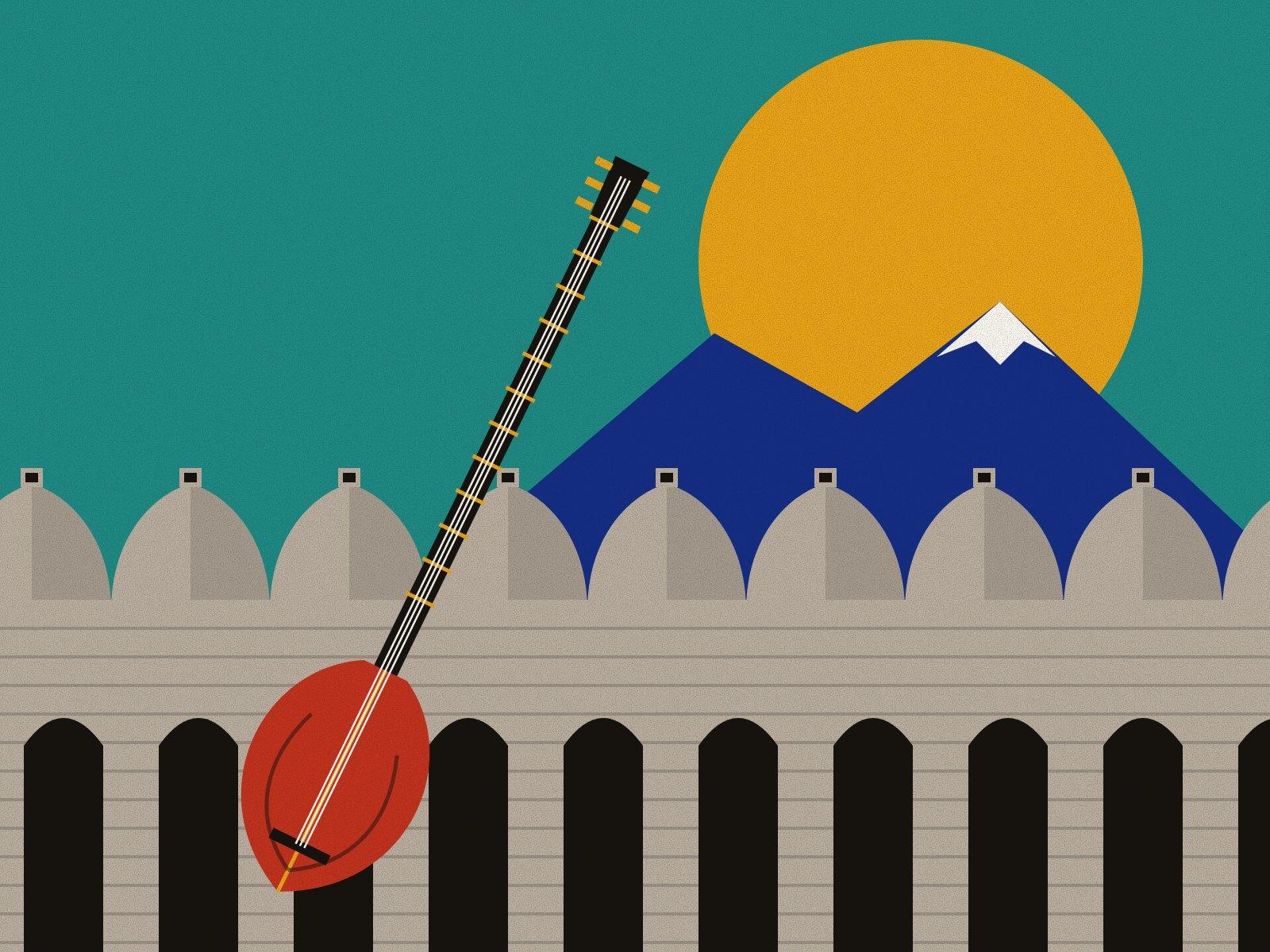
Ashiq, from an Arabic word meaning ‘lover’, is the name of the minstrel of the Azerbaijani-speaking world. An ashiq is at once a poet, a singer, a storyteller and an instrumentalist. The instrument is the saz, a long-necked lute with a deep pear-shaped body and metal strings, struck with a small plectrum. The ashiq performs at weddings, gatherings and festivals, in tea houses and on stage, singing romances and epics, improvising verse and, in a traditional form of contest, matching wits with a rival ashiq in sung riddles and replies.
Ashiq tradition draws on a deep store of stories: the dastans of lovers such as Asli and Karam, the heroic cycle of Koroghlu, and the older world of the Book of Dede Korkut, the epic of the Oghuz Turks, whose bard is himself pictured with a lute, the qopuz. The poetry is in Azerbaijani Turkish and uses strict syllabic forms of its own, the qoshma, gerayli and tajnis among them. Many ashiqs composed their own verses, and the songs of famous masters such as Ashiq Alasgar of Göycha (1821–1926) are sung on both sides of the border.
An ashiq is at once a poet, a singer, a storyteller and an instrumentalist.
In Iran
In Iran, ashiqs are found throughout the Azerbaijani-speaking north-west, in Tabriz, Urmia, Ardabil, Zanjan and the Qaradagh or Arasbaran region along the Aras, as well as among Azerbaijani-speaking communities of Qazvin and Hamadan and among the Qashqai of Fars, who keep their own ashiq tradition. In many places the ashiq plays with a small ensemble: a balaban, a double-reed pipe with a soft, mournful tone, and a qaval, a frame drum. Local styles differ, and the ashiqs of Qaradagh in particular are known for a distinctive repertoire of melodies and stories.
Traditionally an ashiq learned from a master, ustad, through long apprenticeship, and the art passed within families and from teacher to pupil. In the twentieth century radio and recordings carried the ashiq’s songs far beyond the wedding party, and today ashiq houses and associations in Tabriz and elsewhere teach the saz and the repertoire to younger players. Women have a place in the tradition’s history too: Ashiq Pari, a nineteenth-century woman poet of Karabakh, is remembered for her verses and her contests in song.
In the Republic of Azerbaijan
North of the Aras, the ashiq is equally central to the culture of the Republic of Azerbaijan, which defines and presents the tradition as its own. In 2009 UNESCO inscribed the art of Azerbaijani ashiq on the Representative List of the Intangible Cultural Heritage of Humanity, on Azerbaijan’s nomination. Turkey’s related tradition of âşıklık was inscribed in the same year under its own nomination. The ashiqs of Iran and of the Republic share stories, forms and many melodies, while each community keeps its own masters, styles and sense of what the tradition means.
Across Cultureپیوندها
Peoples
Azerbaijanis
Iran’s Azerbaijanis, who often call themselves *Türk*, speak a Turkic language in a land named after an Iranian satrap. North of the Aras, the Republic of Azerbaijan is a separate nation that defines itself.

Languages
Azerbaijani Turkish
The mother tongue of millions in north-western Iran and the official language of the Republic of Azerbaijan, Azerbaijani Turkish is a Turkic language with a deep Persian inheritance and a poetry all its own.
More from Musicموسیقی
The radif and the dastgah
Persian classical music is not written down as compositions but held in the *radif*, a body of melodies passed from master to pupil and arranged into twelve modal systems.
Avaz: the classical voice
In Persian classical music the singer is the centre, and the song is a poem: a ghazal of Hafez, Saadi or Rumi, unfolded line by line in free rhythm and ornamented with the breaking voice of the *tahrir*.
Barbad and the Sasanian court
Barbad, minstrel to Khosrow II, is the most famous musician in Persian memory. Little about him can be proved; much about him has been loved, retold and painted for fourteen centuries.