Azerbaijani Turkish
ترکی آذربایجانیThe mother tongue of millions in north-western Iran and the official language of the Republic of Azerbaijan, Azerbaijani Turkish is a Turkic language with a deep Persian inheritance and a poetry all its own.

Walk through the bazaar of Tabriz and the language you hear is not Persian but Türki, as its speakers in Iran usually call it, or Azerbaijani: Azərbaycan dili in the Republic of Azerbaijan. It is a Turkic language of the Oghuz branch, closely related to Turkish and Turkmen, and the mother tongue of a large share of Iranians. It is spoken across East and West Azerbaijan, Ardabil and Zanjan, in Qazvin and Hamadan, and by a great many people in Tehran, as well as in the Republic of Azerbaijan, where it is the official language, and in Dagestan, Georgia and eastern Turkey.
Oghuz Turkic speech spread into Azerbaijan in the centuries after the Seljuk migrations of the eleventh century, gradually replacing the older Iranian language of the region, which writers of the time called Āzari. Over the following centuries Azerbaijani absorbed a great deal of Persian and Arabic vocabulary, and Persian has in turn borrowed from it: words such as qāshoq ‘spoon’ and otāq ‘room’ came into Persian from Turkic.
Poets of two languages
Azerbaijani has a literature reaching back to the fourteenth century. Nasimi wrote mystical verse in it; Shah Ismail, founder of the Safavid dynasty, wrote poetry under the pen name Khatā’i, and Turkic was a language of the Safavid court. Fuzuli, writing in Baghdad in the sixteenth century, composed his Leyli and Majnun in it, and the epic tales of Dede Korkut are shared with the other Oghuz peoples. Many of these writers were equally at home in Persian, and moved between the two languages without strain.
The best-loved modern poem in Azerbaijani in Iran is Shahriar’s Heydar Babaya Salam, ‘Greetings to Heydar Baba’, published in 1954, an address to a mountain above the poet’s childhood village. Shahriar, who wrote most of his work in Persian, turned to his mother tongue for this elegy to a lost world of village weddings, winter stories and old neighbours, and it is recited by heart on both sides of the Aras.
Many of these writers were equally at home in Persian, and moved between the two languages without strain.
Song and script
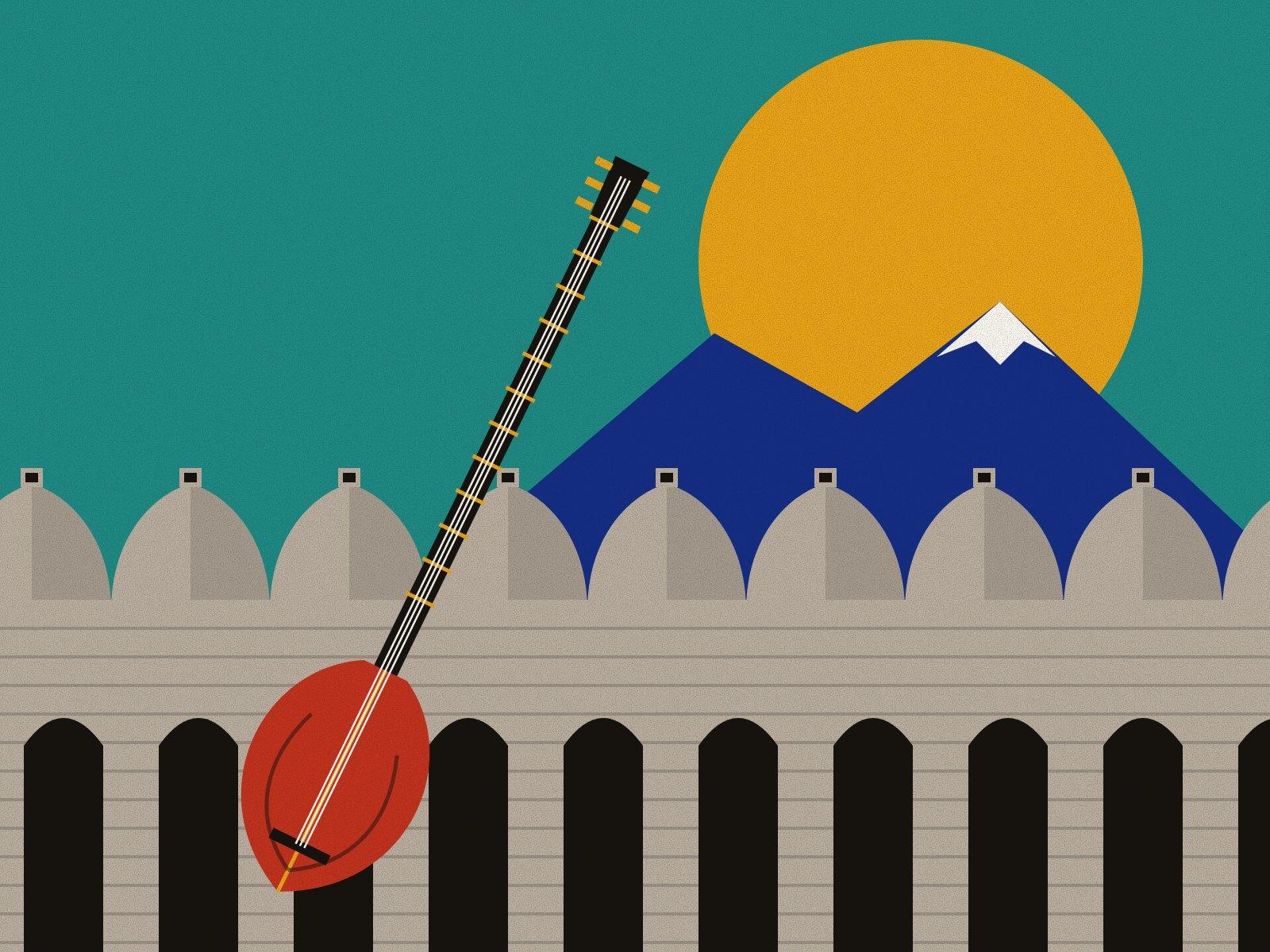
The minstrel tradition of the ashiq, a singer-poet who accompanies himself on the long-necked saz, is at the heart of Azerbaijani culture; UNESCO added the art of the Azerbaijani ashiq to its list of intangible heritage in 2009. In Iran the language is written in the Perso-Arabic script, while the Republic of Azerbaijan has changed alphabets three times in a century, from Arabic to Latin in 1929, to Cyrillic in 1939, and back to a Latin alphabet after independence in 1991. Persian is the language of schooling in Iran. Minority Rights Group International and other observers have reported limits on education in Azerbaijani and the arrest of activists campaigning for language rights, while Azerbaijani publishing, music and broadcasting continue to flourish in Tabriz and beyond.
Across Cultureپیوندها
Music
The ashiq and the saz
Poet, singer, storyteller and player of the long-necked saz, the *ashiq* is the minstrel of the Azerbaijani-speaking world, on both banks of the Aras.
Peoples
Azerbaijanis
Iran’s Azerbaijanis, who often call themselves *Türk*, speak a Turkic language in a land named after an Iranian satrap. North of the Aras, the Republic of Azerbaijan is a separate nation that defines itself.
More from Languagesزبانها

Persian
Spoken in Tehran, Kabul and Dushanbe under three names and written in two alphabets, Persian is one language with three national standards and a thousand years of shared poetry.

Old Persian and the cuneiform inscriptions
Carved into cliffs and palace walls in a script of wedges, Old Persian is the oldest recorded form of the Persian language, and the key that unlocked the cuneiform world.

Avestan
Known only from the sacred texts of Zoroastrianism, Avestan is one of the two oldest recorded Iranian languages, and it is still recited daily in fire temples in Yazd, Tehran and Mumbai.