Shab-e Yalda
شب یلداThe longest night of the year. Families gather at the home of their eldest, eat pomegranates, watermelon and ajil, read Hafez and the Shahnameh, and stay up together until the dark has turned.

Shab-e Yalda is the night between the last day of autumn, 30 Azar, and the first day of winter, 1 Dey: the winter solstice, the longest night of the year in the northern hemisphere, which falls on the evening of 20 or 21 December. It is also called Shab-e Chelleh, 'the night of the forty', because it opens the chelleh-ye bozorg, the 'great forty', the first forty days of winter, which a 'small forty' later follows. It is a night for family. People gather, often at the home of the eldest relative, and stay up late eating, talking and reading poetry, keeping one another company until the dark has passed its peak.
Pomegranates, watermelon and Hafez
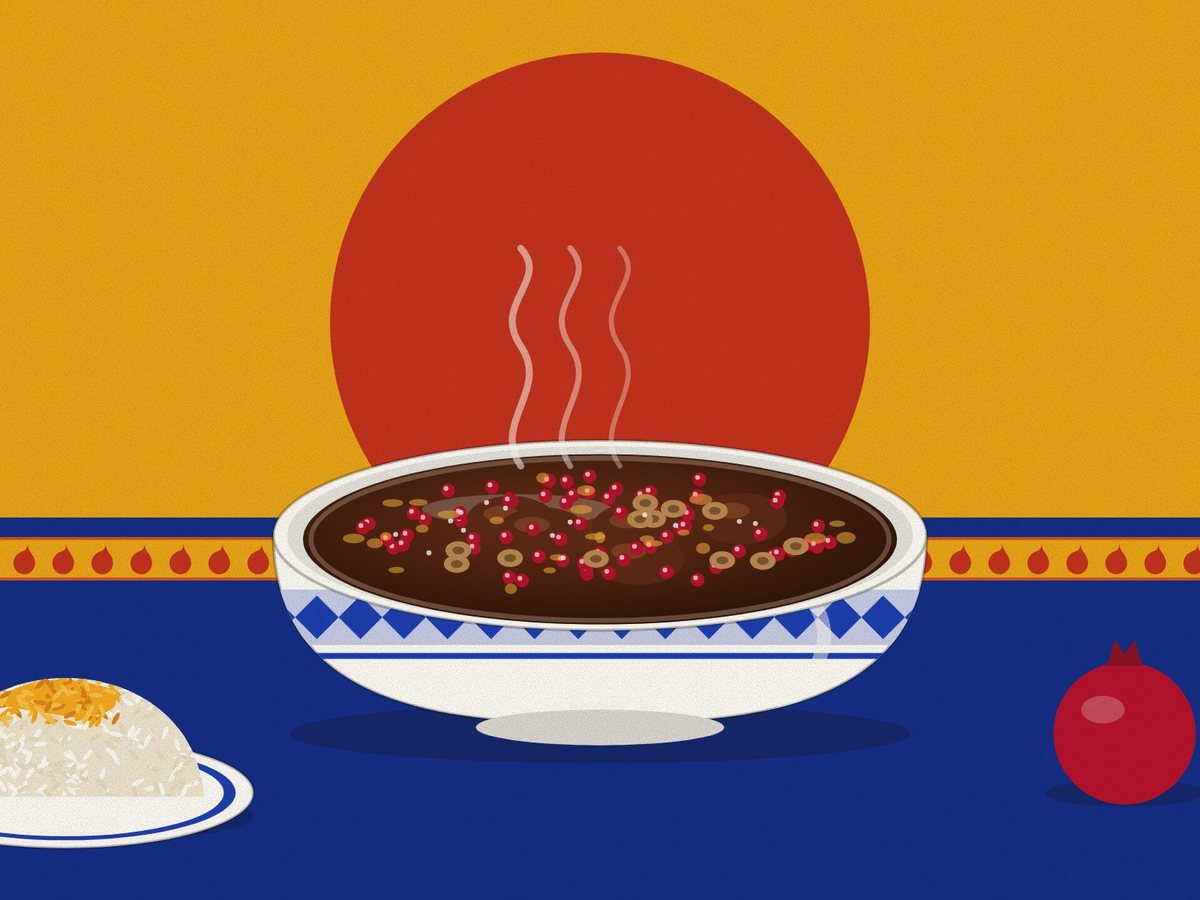
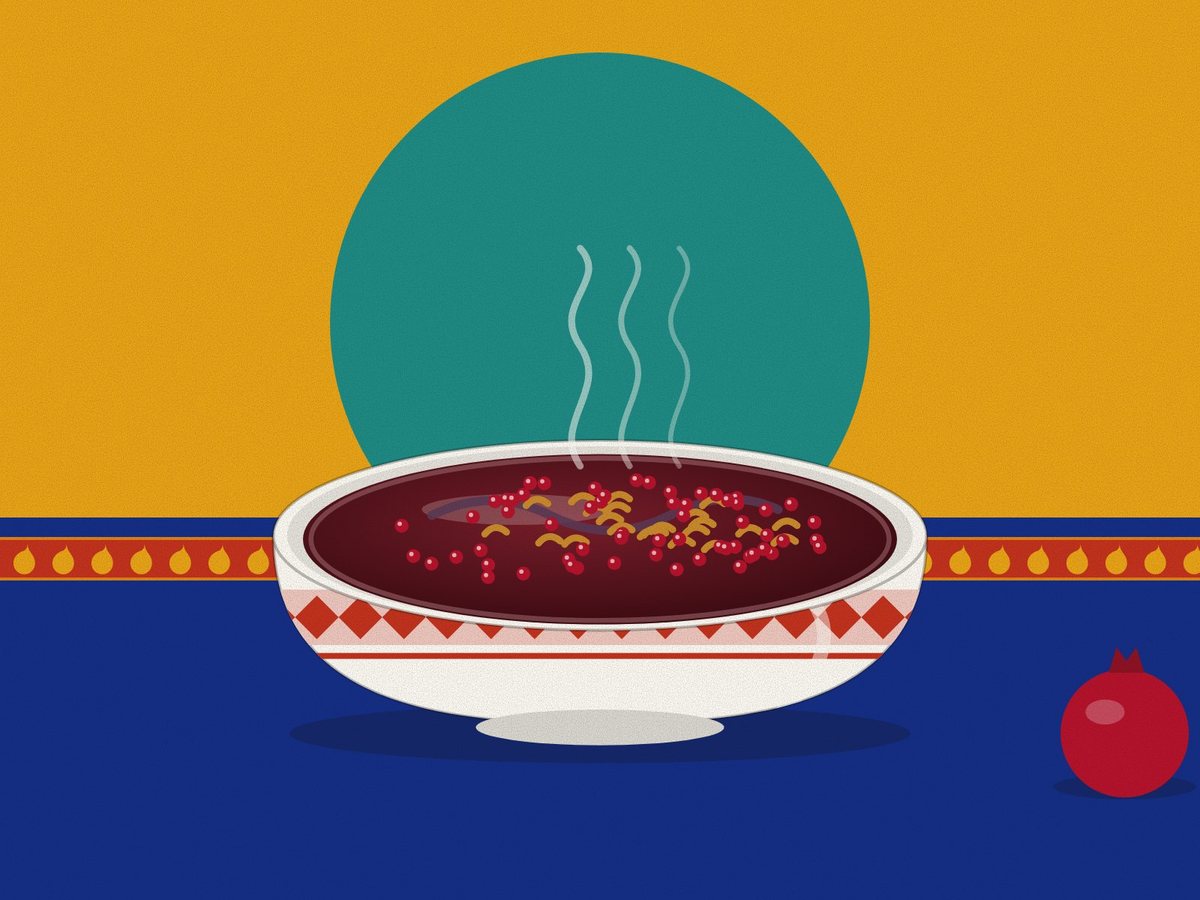
The table is red. Pomegranates (anar), split open or seeded into bowls, and watermelon (hendevaneh), often kept since summer for the purpose, are the two fruits found on almost every Yalda table, and their red is commonly said to stand for the dawn and the glow of life. Persimmons, grapes and jujubes often join them, along with ajil, the mix of nuts, roasted seeds and dried fruit, and dried apricots and peaches. A popular belief holds that whoever eats watermelon on Yalda will be spared the heat and sickness of the coming summer. Many families eat dinner first, sabzi polo with fish, or ash-e reshteh, and in some places forty kinds of food are set out for the night of the forty. In Khorasan, above all in Gonabad and Birjand, families whisk kafbikh, a white, marshmallow-like sweet made from the boiled root of a desert plant. Before gas heating, the family would sit with their legs under the korsi, a low table over a brazier covered with a great quilt, with the fruit set out on top.
Then comes the poetry. Someone opens the Divan of Hafez, the fourteenth-century poet of Shiraz, for each person in turn. This is the fal-e Hafez: the listener makes a silent wish or asks a question, the book is opened at random, and the ghazal on the page is read aloud as the answer. A popular saying warns against asking Hafez more than three times in one night. Elders tell stories, and in many homes someone reads from Ferdowsi's Shahnameh. Gifts go to children, and in some families dried fruit and nuts, wrapped in tulle and tied with ribbon, are given to friends and relatives, above all to a new bride. One of Hafez's own couplets has become part of the night:
صحبت حکام ظلمت شب یلداست
نور ز خورشید جوی بو که برآید
The company of the rulers of darkness is the night of Yalda;
seek light from the sun, and perhaps it will rise.
The word and the night
The custom is older than its name. In Zoroastrian tradition the longest night was an inauspicious one, when the forces of Ahriman were thought to be at their strongest, and the customs of the night are often explained as ways of getting through it safely: staying awake, staying together, and sharing the last fruit of summer. The next day, the first of Dey, was a feast. Al-Biruni records it as Khorram-ruz, 'the joyful day'.
The word yalda came later, and from elsewhere. It is Syriac for 'birth', and Syriac-speaking Christians in the Parthian and Sasanian lands used it for the feast of the Nativity, which they kept near the solstice. The dictionary of Ali-Akbar Dehkhoda explains the name this way. When and where the word passed into Persian is not known, but in time Shab-e Yalda and Shab-e Chelleh became two names for the same night. Many modern accounts link Yalda with the birth of Mithra; scholars generally find no support for this in the Iranian sources, and trace the idea to older theories, now abandoned, about the Roman cult of Mithras.
Across the Persian-speaking world
In 2022 UNESCO inscribed Yalda/Chella on its Representative List of the Intangible Cultural Heritage of Humanity, as a joint file of Iran and Afghanistan. Its description could be of almost any family's night: relatives gathered at the houses of elders around a table with a lamp for light, water for cleanliness and red fruit for warmth, pomegranates, watermelons, beetroots, jujubes and grapes; poetry, storytelling, games and music; and presents for new in-laws, brides and children. In Afghanistan, where the night is called Shab-e Chella, the markets of Herat fill with pomegranates in the days before. The night is also kept in Tajikistan and among Kurds.
In Iran, fruit sellers and bazaars are crowded in the days before. In late 2023 Iran's Supreme Council of the Cultural Revolution added a new official title for the day to the state calendar, 'day of promoting the culture of hospitality and ties with kin'. The change drew wide public comment, and the council's spokesman said the old festival names had not been removed. In the diaspora, families and community groups gather in the same way, with a pomegranate on the table and a copy of Hafez within reach.
When it fallsکی
In the Persian calendar it keeps its day; in the Gregorian calendar the day moves a little from year to year.
Monday, 21 December 2026
Tuesday, 21 December 2027
Wednesday, 20 December 2028
At the tableسفره


Across Cultureپیوندها
Mythology
Ahura Mazda and Ahriman
The Wise Lord and the Hostile Spirit: the oldest Iranian account of a world in which every person takes a side, and the moral heart of a faith still practised today.

Faiths
Christianity in Iran
From the Church of the East under the Sasanians to the frescoes of Vank Cathedral, Christianity has been part of Iran for nearly two thousand years.

Faiths
Mithra and the old Iranian gods
Before and beside Zarathushtra stood older Iranian divinities: Mithra of the covenant, Anahita of the waters, Verethragna of victory. Their names survive in hymns, festivals and children.
Peoples
Tajiks
Tajiks speak Persian in Afghanistan, Tajikistan and Uzbekistan. They are heirs of the Samanids and of Rudaki, and their homelands define themselves.
More from Festivalsجشنها

Nowruz
The Persian new year, Nowruz, 'new day', begins at the moment of the March equinox. Homes are cleaned, the haft-sin is laid, and families visit one another across Iran, Afghanistan, Central Asia, the Caucasus and the diaspora.

Sizdah Bedar
On the thirteenth day of the new year, families leave their homes for parks, rivers and hillsides, throw the sabzeh from the haft-sin into running water and knot blades of grass for a wish. In Iran it is officially Nature Day.

Tirgan
A midsummer festival of water on Tir day of the month of Tir. People splash one another, tie a rainbow cord round the wrist, and remember Tishtrya, the star who brings rain, and the arrow of Arash.