Tirgan
تیرگانA midsummer festival of water on Tir day of the month of Tir. People splash one another, tie a rainbow cord round the wrist, and remember Tishtrya, the star who brings rain, and the arrow of Arash.

Tirgan falls on 13 Tir, in the first days of July, early in the long dry summer. Its name comes from the old Zoroastrian calendar, in which each day of the month had a name as well as each month. Where the two met, a feast followed, and Tir day of the month of Tir became Tirgan. It is not a public holiday in Iran. Where it is kept, by families, villages and Zoroastrian communities, it has the easy feel of a summer day spent out of doors, near water, with friends.
Water, wishes and a coloured cord
Water is at the centre of the day. People splash one another, children play in fountains and streams, and the splashing is usually explained as a wish for good rain in the year to come. Dishes linked with the day include a spinach ash and sholeh-zard, the saffron rice pudding.
The best-known custom is the tir-o-bad, a cord twisted from threads of many colours, seven in some accounts, which is tied round the wrist at the start of the feast. In one widely told version it stays there until Bad day, nine days later, the day named for the wind. Then it is untied and let go to the wind from a rooftop or another high place, carrying its wearer's wishes away with it. Other accounts have it thrown into running water. In Farahan, near Arak, the day has also had its own fortune game, fal-e kuzeh. Small belongings, a ring or a coin, are dropped into a jar of water. After the splashing, the older people sing short verses in turn, a girl draws one object from the jar after each, and the verse is taken as the fortune of the object's owner.
The star and the archer
Two stories meet in Tirgan. The first belongs to Tishtrya, the star Sirius, praised in the Avesta's hymn to him, the Tir Yasht. Tishtrya appears for ten nights as a young man of fifteen, for ten as a bull with golden horns and for ten as a white horse with golden ears. As the white horse he goes down into the cosmic sea and fights Apaosha, the demon of drought, who takes the form of a black horse. Tishtrya loses the first fight. Strengthened by worship, he wins the second, the waters flow, and rain falls on the seven regions of the earth. The month of Tir takes its name from him.
The second story belongs to Arash. The same hymn compares Tishtrya's flight to the arrow shot by Erekhsha, best of the Iranian archers, from one mountain to another far away. Later writers made the comparison into a tale. The eleventh-century scholars al-Biruni and Gardizi both tell of a war between Manuchehr of Iran and Afrasiyab of Turan, ended by agreement that the border would lie wherever a single arrow fell. Arash shot it. In al-Biruni's telling the wind carried the arrow from the mountains near Amol to the far frontier of Khorasan; Gardizi has it come down between Farghana and Bactria. Both connect the shot with Tirgan. Not every scholar accepts the link. The mythologist Abolqasem Esmailpour has argued that the day belonged to Tishtrya alone, and that Arash was drawn in later through the hymn's comparison and through the single word tir, which names the star, the planet Mercury, the month and an arrow.
Tirgan today
Tirgan has outlasted most of the old name-day feasts. Zoroastrians mark it, and it is kept in towns and villages around Yazd, Meybod and Ardakan, Kerman, Shiraz and Isfahan, as well as in Tehran. Because the modern Iranian calendar gives its first six months thirty-one days, some who keep the old count of thirty-day months celebrate on 10 Tir instead. In Farahan, in Markazi province, the Tirgan of the village of Zolfabad was entered on Iran's national list of intangible heritage in the winter of 2010 to 2011. Along the Caspian, in Mazandaran and Gilan, the feast survives as Tirma Sizeh Shu, 'the night of the thirteenth of Tir', counted by the old local calendar, so that it no longer falls in the solar month of Tir.
Arash has had a long modern life. Siavash Kasraei's poem Arash-e Kamangir (1959) made him a symbol of sacrifice for one's land, and many later tellings set the famous shot on the summit of Damavand. In the diaspora the name has travelled furthest in Toronto, where the Tirgan Festival, a large festival of Iranian arts and culture first held in 2006, takes its name from the old feast. Its organisers tell the story of Arash, whose arrow drew a border wide enough to hold many peoples, as a picture of Iran's many cultures. The wrist cords and the splashing, meanwhile, go on in courtyards and parks wherever families keep the day.
When it fallsکی
In the Persian calendar it keeps its day; in the Gregorian calendar the day moves a little from year to year.
Sunday, 4 July 2027
Monday, 3 July 2028
Tuesday, 3 July 2029
Poetsشاعران
Siavash Kasraei
سیاوش کسراییPoet of Arash the Archer, who retold an ancient Iranian legend of sacrifice in the new verse of Nima.
Across Cultureپیوندها
Mythology
Arash the archer
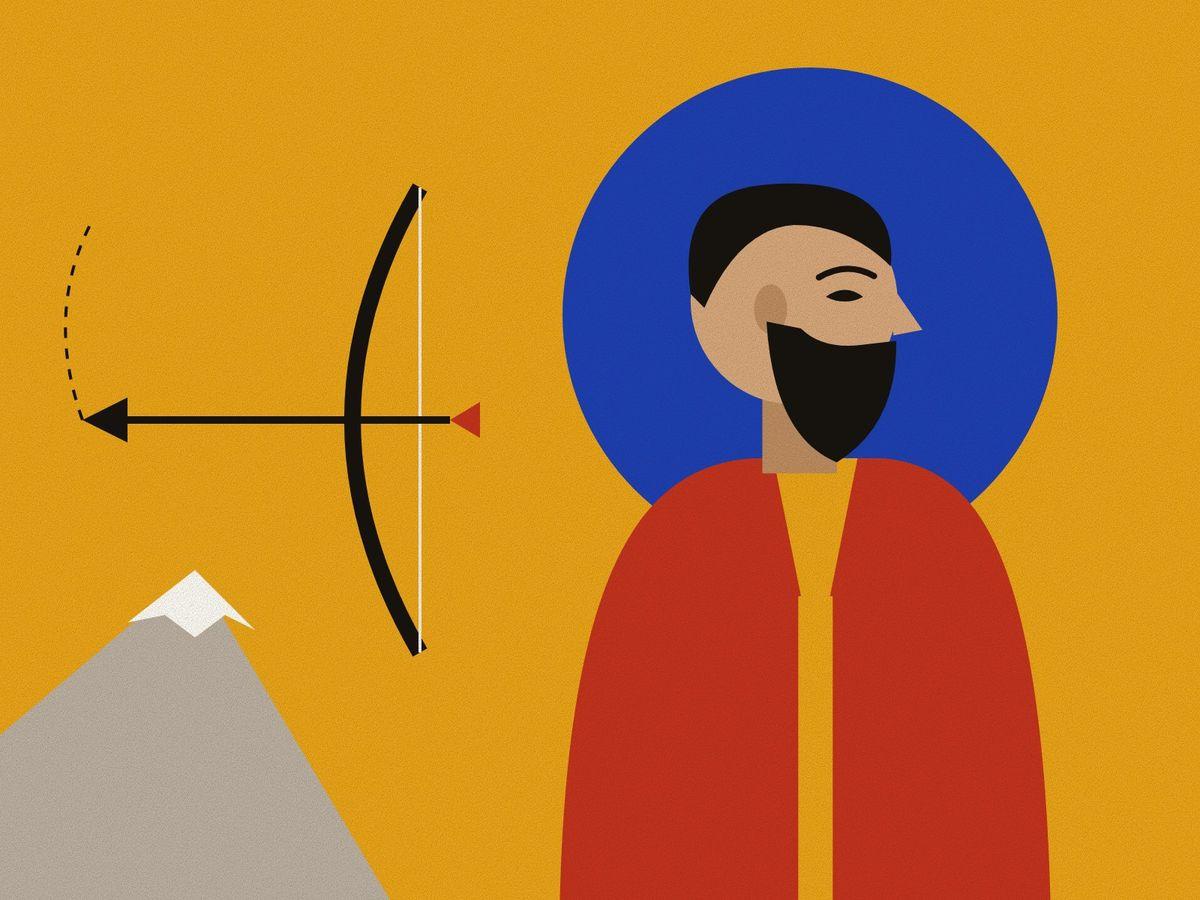
To end a war, the border of Iran would be drawn wherever one arrow fell. Arash climbed a mountain and put everything he had into the shot.

Faiths
Mithra and the old Iranian gods
Before and beside Zarathushtra stood older Iranian divinities: Mithra of the covenant, Anahita of the waters, Verethragna of victory. Their names survive in hymns, festivals and children.
Faiths
Zoroastrianism
Good thoughts, good words, good deeds: the faith of Zarathushtra, kept by its followers in Yazd, Kerman, Tehran, Mumbai and far beyond.

Peoples
Gilaks and Mazandaranis
On the green Caspian shore, Gilaks and Mazandaranis speak their own Iranian languages, grow rice, tea and citrus, and keep festivals and a calendar of their own.
More from Festivalsجشنها

Nowruz
The Persian new year, Nowruz, 'new day', begins at the moment of the March equinox. Homes are cleaned, the haft-sin is laid, and families visit one another across Iran, Afghanistan, Central Asia, the Caucasus and the diaspora.

Sizdah Bedar
On the thirteenth day of the new year, families leave their homes for parks, rivers and hillsides, throw the sabzeh from the haft-sin into running water and knot blades of grass for a wish. In Iran it is officially Nature Day.

Mehregan
The autumn feast of Mehr, or Mithra, god of covenants and friendship. For centuries it stood beside Nowruz as one of the two great feasts of the Persian year; Zoroastrians and Tajiks keep it still.