Turkmen
ترکمنهاIran’s Turkmen live on the Turkmen Sahra plain north of the Alborz. They keep the poetry of Magtymguly, the music of the *bagshy*, red carpets and a passion for horses.
North of the Alborz, where the forests of Golestan give way to open steppe, lies the Turkmen Sahra, ‘the Turkmen plain’. Its towns, Gonbad-e Kavus, Bandar Torkaman and Aq Qala, and its villages are home to Iran’s Turkmen, who call themselves Türkmen. There are Turkmen communities too in North and Razavi Khorasan. Across the border, Turkmenistan has been an independent state since 1991 and defines itself; the Treaty of Akhal of 1881 drew the line between Persia and the Russian Empire that runs through Turkmen lands.
Language, faith and tribe
Turkmen is an Oghuz Turkic language, related to Azerbaijani and Turkish. Most Turkmen are Sunni Muslims of the Hanafi school. Tribal identity remains strong: in Iran the largest tribes are the Yomut, on the plain towards the Caspian, and the Göklen, in the hills to the east, each with its own clans, dialect features and carpet designs. Most Iranian Turkmen also speak Persian; in Iran Turkmen is written in the Perso-Arabic script, while Turkmenistan has used a Latin alphabet since the 1990s. For centuries much of Turkmen life was pastoral and mobile, with felt yurts (öý) and herds of sheep, camels and horses.
Poetry and music
The national poet of all Turkmen, Magtymguly Pyragy, lived in the eighteenth century, and his grave, beside that of his father, the poet Azadi, lies in the village of Aq Taqeh in Golestan province. Turkmen from both sides of the border come to it as pilgrims. His verses, about unity, the transience of life and the beauty of his land, are sung by bagshy, bards who accompany themselves on the two-stringed dutar. The music of the bakhshi of Khorasan, including Turkmen, Kurdish and Persian singers, was inscribed by UNESCO in 2010.
Turkmen from both sides of the border come to it as pilgrims.
Horses and carpets
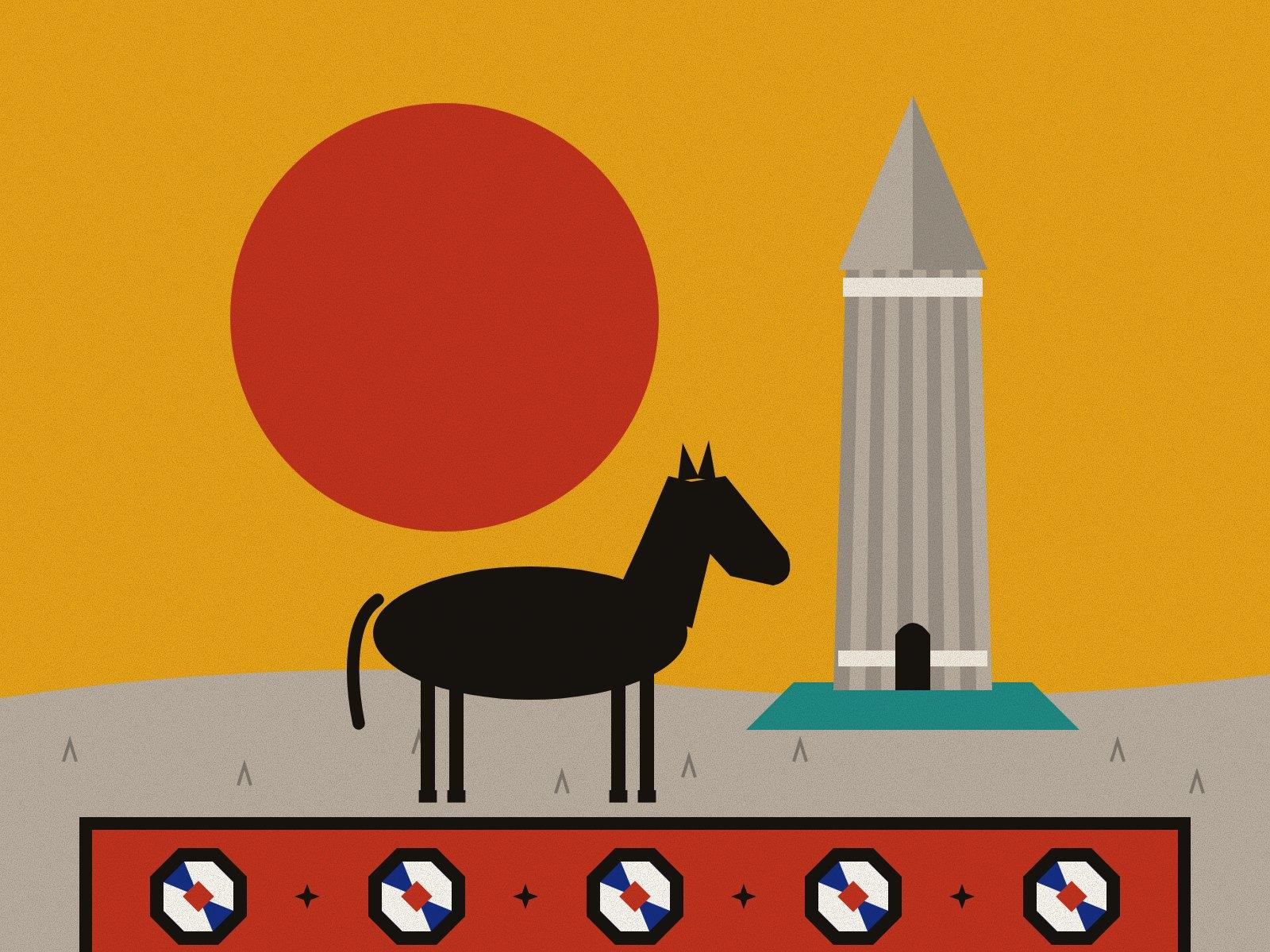
The Turkmen horse, lean, fast and enduring, is close kin to the Akhal-Teke of Turkmenistan, and horse racing in Gonbad-e Kavus draws crowds every spring and autumn. Turkmen carpets are known around the world by their deep reds and repeated medallions, the göl, each tribe once having its own; the trade long sold them as ‘Bokhara’. Women’s dress is red and green silk with heavy silver jewellery, and a married woman’s tall headdress is a sign of status. Bread baked in clay ovens and chekdirme, a rice and meat dish, belong to every celebration.
In Gonbad-e Kavus stands the brick tower of Gonbad-e Qabus, built in 1006–1007 for the Ziyarid ruler Qabus ibn Voshmgir and a UNESCO World Heritage site since 2012. A band of Kufic inscription round its base names its builder and the year. It is older than Turkmen settlement on the plain, but Turkmen have lived in its shadow for centuries, and it has become the emblem of their town.
Across Cultureپیوندها

Faiths
Sunni Islam in the Iranian world
Sunni Islam is the faith of most Muslims in Afghanistan and Tajikistan, of Kurds, Baluch and Turkmen in Iran, and of the great scholars of medieval Khorasan.

Languages
Armenian, Assyrian, Turkmen and other languages of Iran
Iran’s languages include ancient tongues of Christian and Jewish communities, Turkic languages of the north and south, and small languages found nowhere else, from the Armenian of New Julfa to the Kumzari of the Strait of Hormuz.
Music
The bakhshis of Khorasan
In northern Khorasan, singers called *bakhshi* tell epics and love stories to the two-stringed dotar, in Kurdish, Turkic, Turkmen and Persian. Their music was inscribed by UNESCO in 2010.
More from Peoplesمردمان
Persians
Persian speakers of Iran call themselves *Fars* or simply *Irani*. They are one people among many in Iran, and their language became a shared tongue for far more than themselves.
Azerbaijanis
Iran’s Azerbaijanis, who often call themselves *Türk*, speak a Turkic language in a land named after an Iranian satrap. North of the Aras, the Republic of Azerbaijan is a separate nation that defines itself.

Kurds
Kurds live across the Zagros and Taurus in Iran, Iraq, Turkey and Syria. In Iran they speak several Kurdish languages, keep several faiths, and light Newroz fires that every Iranian knows.