Sadeh
سدهA midwinter fire festival held fifty days before Nowruz, when a great bonfire is lit at dusk. The Shahnameh credits the first Sadeh fire to King Hushang; the Zoroastrians of Kerman and Yazd still light it.
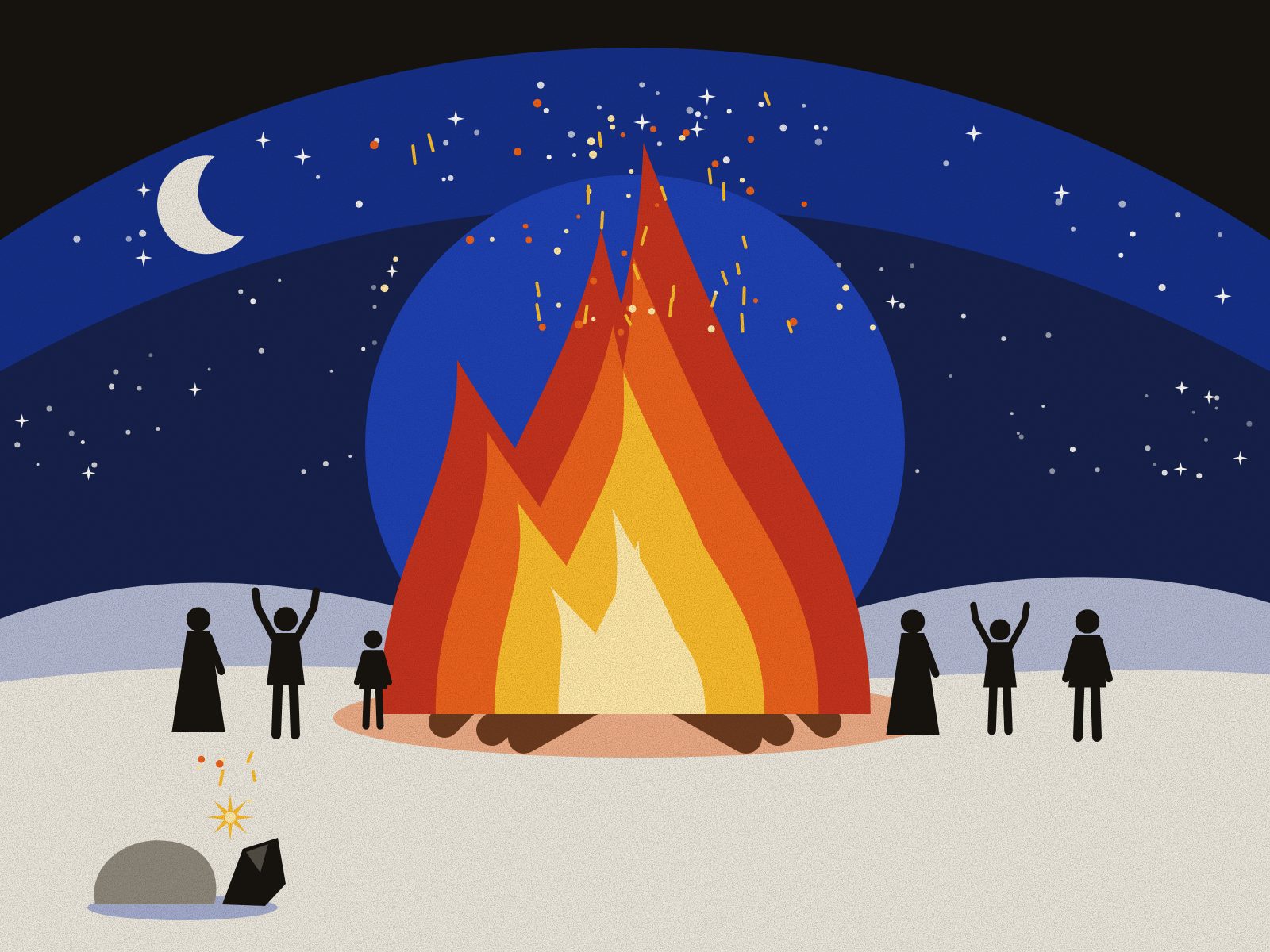
Sadeh is a festival of fire in the depth of winter. On the evening of 10 Bahman, at the end of January, a great pile of brushwood is lit at dusk, and people gather round it to pray, sing, dance and watch the flames climb. It falls in the hardest stretch of the cold, where the 'great forty' days of winter give way to the 'small forty', and the fire is commonly explained as a way of warming the earth and driving back the frost. In the countryside it also marks the start of the farming year: UNESCO's description speaks of fields made ready for spring, trees pruned, and villagers clearing streams and pools together.
The fire at dusk
The fuel is gathered beforehand. Among Zoroastrians it was, and in some places still is, the task of boys and young men to go out to the hills the day before and bring back camel thorn and other desert brush, and a boy's first gathering was a small rite of passage, celebrated at home. In Kerman the pile is raised in the Bodagh-abad garden beside the shrine of Shah Mehr Izad. One remembered account of the 1960s describes two mobeds, Zoroastrian priests, coming out at sunset in white with lanterns in their hands, murmuring prayers, walking three times round the pile and lighting it from all four sides. People waited for the blaze to die down so that the young could jump over the scattered burning bushes, and farmers carried some of the ash home to their fields, believing that the ash of Sadeh brings blessing. In Kerman the night is also called sadeh-suzi, 'the burning of Sadeh'. Around the fire there are prayers and songs, offerings of dried and fresh fruit, and traditional dishes.
A hundred, and other reckonings
Sadeh means 'hundred'. Al-Biruni gives several explanations. If days and nights are counted separately, a hundred of them remain before the end of the year, fifty days and fifty nights before Nowruz. Others said that on this day the descendants of the first human beings first numbered a hundred. Another reckoning counts a hundred days from the start of the old five-month winter.
The best-loved story comes from the Shahnameh. The legendary king Hushang, riding in the mountains, sees a monstrous black serpent and hurls a stone at it. The serpent escapes, but the stone strikes another rock and fire leaps from the two. Hushang gives thanks for the light, and that night he builds a fire as high as a mountain and holds a feast around it:
یکی جشن کرد آن شب و باده خورد
سده نام آن جشن فرخنده کرد
That night he held a feast and drank wine,
and he named that blessed feast Sadeh.
Not every source agrees. Al-Biruni says nothing of fire being discovered, and the Nowruznameh, a Persian treatise attributed to Omar Khayyam, says that Fereydun founded the feast on the day he seized Zahhak.
From Mardavij to Kerman
In the early Islamic centuries Sadeh was, with Nowruz and Mehregan, one of the great feasts kept by rulers as well as by ordinary people, and the writings of al-Biruni, Gardizi and Beyhaqi all mention it. The most famous celebration was given in Isfahan in 323 AH (935 CE) by Mardavij, the Zoroastrian-born founder of the Ziyarid dynasty, who dreamed of restoring the old Iranian kingship. Stacks of wood were piled on both banks of the Zayandeh Rud and up a hillside from foot to summit, and birds daubed with naphtha were set alight and released into the dark. The chroniclers say that Mardavij thought it all too small and would not attend. Not long afterwards he was killed in his bath by his own Turkish slaves. Beyhaqi describes another Sadeh, at the court of the Ghaznavid sultan Masud in 430 AH (1039 CE).
Today Kerman holds the best-known Sadeh in Iran. The Zoroastrian Anjoman of Kerman lights the fire each year on 10 Bahman before thousands of Kermanis, Muslims, Zoroastrians and others, and the celebration was entered on Iran's national list of intangible heritage in 2009. Fires are also lit by the Zoroastrians of Yazd and the villages around Meybod, Ardakan and Bafq, and in Tehran at the Zoroastrian garden of Kushk-e Varjavand. In 2023 UNESCO inscribed the Sadeh/Sada celebration as a joint file of Iran and Tajikistan, where, in 2018, the president greeted the nation on the festival for the first time. In recent winters people have lit Sadeh fires in many Iranian cities, from Tabriz to Shiraz, and Iranian communities abroad gather round fires of their own, joining hands to dance in a circle round the flames.
When it fallsکی
In the Persian calendar it keeps its day; in the Gregorian calendar the day moves a little from year to year.
Saturday, 30 January 2027
Sunday, 30 January 2028
Monday, 29 January 2029

Across Cultureپیوندها
Faiths
Zoroastrianism
Good thoughts, good words, good deeds: the faith of Zarathushtra, kept by its followers in Yazd, Kerman, Tehran, Mumbai and far beyond.

Mythology
Kayumars and the first kings
In Ferdowsi's Shahnameh, history begins on a mountainside with a king in a leopard skin, and the gifts of civilisation are won one by one: fire, iron, tamed animals, writing.
Mythology
Zahhak and Kaveh the blacksmith
A king with serpents growing from his shoulders, and the blacksmith who raised his leather apron on a spear and brought him down.
Peoples
Tajiks
Tajiks speak Persian in Afghanistan, Tajikistan and Uzbekistan. They are heirs of the Samanids and of Rudaki, and their homelands define themselves.
More from Festivalsجشنها

Nowruz
The Persian new year, Nowruz, 'new day', begins at the moment of the March equinox. Homes are cleaned, the haft-sin is laid, and families visit one another across Iran, Afghanistan, Central Asia, the Caucasus and the diaspora.

Sizdah Bedar
On the thirteenth day of the new year, families leave their homes for parks, rivers and hillsides, throw the sabzeh from the haft-sin into running water and knot blades of grass for a wish. In Iran it is officially Nature Day.

Tirgan
A midsummer festival of water on Tir day of the month of Tir. People splash one another, tie a rainbow cord round the wrist, and remember Tishtrya, the star who brings rain, and the arrow of Arash.