The Kar fish
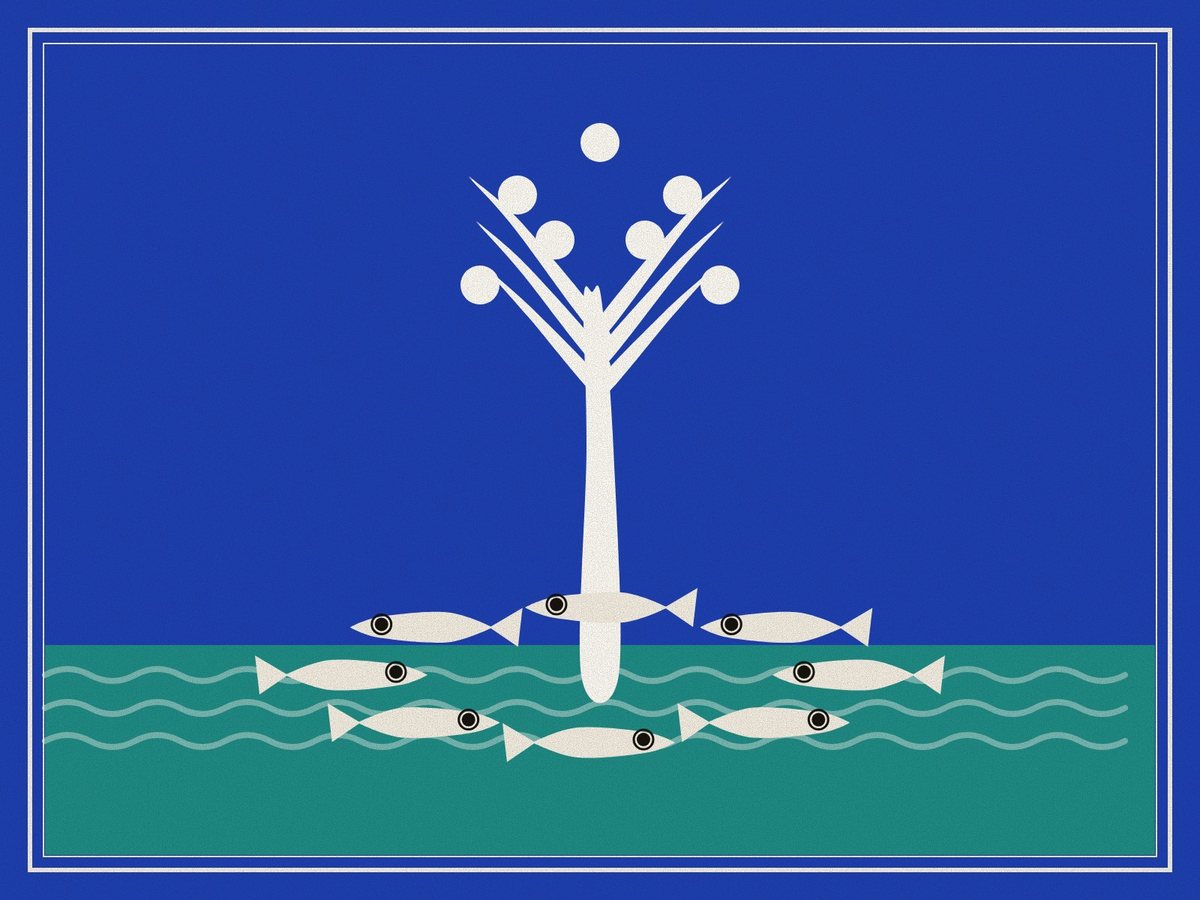
کر ماهیThe keen-eyed fish who circles the sacred white Hom tree in the cosmic sea, keeping watch against the creature Ahriman sent to destroy it.
In the Avesta, the hymn to Verethraghna, the spirit of victory, lists the gifts he grants. One of them is the eyesight of the Kara fish, which can see a ripple as fine as a hair in the depths of the river Raŋhā, the great river at the edge of the mythic world. The fish became a byword for watchfulness, and the Middle Persian tradition gives it a job worthy of that sight.
Guarding the white Hom
According to the Bundahishn, in the middle of the cosmic sea, called Vourukasha in the Avesta and Frāxkard in Middle Persian, grows the white Hom, also called Gōkarn. It is the tree whose sap will make the bodies of the dead immortal at the final renewal of the world. Ahriman, the Destructive Spirit, sent a creature into the sea to gnaw at it, often translated as a frog or lizard. To protect the tree, the Kar fish swim around it without rest, a company of them, so that one is always facing the attacker. They are said to need no food but the spiritual nourishment of their duty.
They swim around the tree without rest, so that one is always facing the attacker.
The Kar fish belongs to a carefully balanced cosmos in which every good creation has a protector. Alongside the three-legged ass and the bird Chamrosh, it shows the Zoroastrian habit of picturing the natural world as a field of watchful, faithful creatures.
Where Vourukasha might be has been argued for over a century. Some scholars thought of the Caspian, others of the Aral Sea, and many now treat it as a purely mythic ocean. The Atlas pin marks the Caspian shore at Anzali only as one of the waters people have connected with it. For illustrators, the Kar fish is an invitation to draw a ring of fish circling a tree that grows out of the sea.
Across Cultureپیوندها
Mythology
Ahura Mazda and Ahriman
The Wise Lord and the Hostile Spirit: the oldest Iranian account of a world in which every person takes a side, and the moral heart of a faith still practised today.
More from Folk creaturesموجودات افسانهای
Al
A female being said to haunt women in the days after childbirth, feared across Iran and among its neighbours, and kept at bay with iron, onion and company.
Div
Once a word for gods, the div became the great demon of Iranian story: an enemy of order in the Avesta, a captive scribe in the Shahnameh, and a horned giant in grandmothers' tales.

The White Div
The lord of the divs of Mazandaran, who blinded a king and his army, and whose blood restored their sight after Rostam killed him in his cave.