Ghul of the desert
غول بیابانیThe desert shape-shifter who calls travellers by name and leads them astray, a fear as old as the caravan routes across the salt plains.
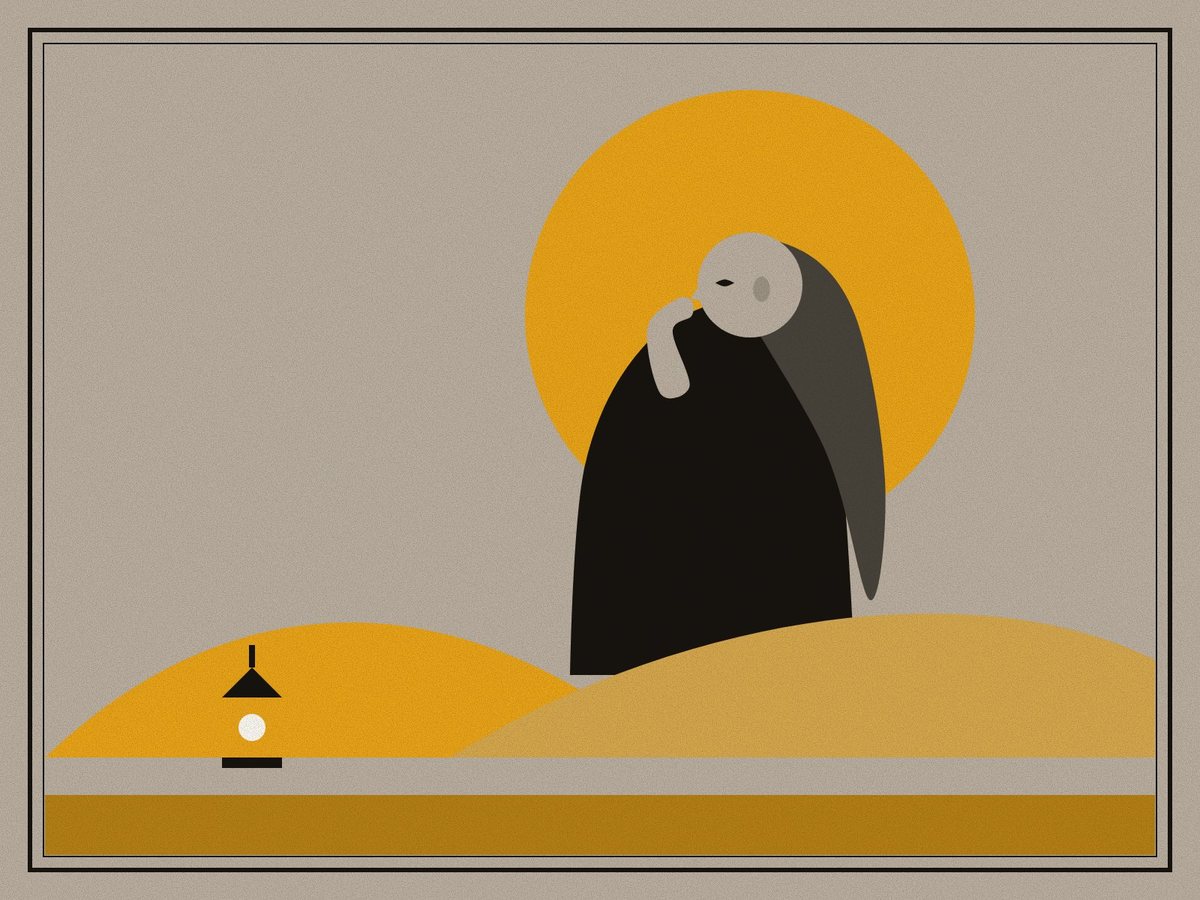
The great salt deserts of central Iran, the Dasht-e Kavir and the Dasht-e Lut, were crossed for centuries by caravans that travelled at night to escape the heat. It is not surprising that they had their own terror. The ghul, and especially the ghul-e biyābāni, the ghul of the open desert, was said to lurk there, taking on shapes to deceive travellers: a companion, a woman, a familiar voice calling a man's name from the dark. Whoever followed would be led away from the road, lost and, in many stories, devoured.
The word is shared with Arabic, where the ghūl is an old desert being, and the figure belongs to a common Middle Eastern world of belief. In Persian it took deep root. Classical poets use the ghul of the desert as an image of anything that leads people off the right path, and the Encyclopaedia Iranica traces the creature through literature and folklore from Iran to Afghanistan.
A familiar voice calling a man's name from the dark.
The ghul in folk tales
In folk tales the ghul is usually female, huge and fearsome, sometimes with breasts so long she throws them over her shoulders. Yet she can be tamed. A recurring motif in Persian and Afghan tales has the hero creep up and suckle at her breast before she sees him, making himself her foster-son, after which she must help rather than harm him. Other tales show the ghul as a cannibal mother whose children the hero must outwit.
In everyday Persian, ghul is used for a giant of a person, and ghul-e cherāgh, "the ghul of the lamp", is the Persian name for the genie of Aladdin. The ghul of the desert survives in children's warnings, in sayings and in storytellers' repertoires, a reminder of how dangerous the empty roads between oasis towns once were.
More from Folk creaturesموجودات افسانهای
Al
A female being said to haunt women in the days after childbirth, feared across Iran and among its neighbours, and kept at bay with iron, onion and company.
Div
Once a word for gods, the div became the great demon of Iranian story: an enemy of order in the Avesta, a captive scribe in the Shahnameh, and a horned giant in grandmothers' tales.
The White Div
The lord of the divs of Mazandaran, who blinded a king and his army, and whose blood restored their sight after Rostam killed him in his cave.