The Shahnameh atlas · The heroic age
Kuh-e Khwaja
کوه خواجهA basalt island in the Hamun that local legend calls Rostam's castle
- Traditionally placed here · Sistan and Baluchestan in the Atlas
- Rostam, Zal
The Shahnameh gives Rostam no single castle with a name you can find on a map. But in Sistan, legend has always pointed to one place: Kuh-e Khwaja, a flat-topped mesa of black basalt that rises from the bed of Lake Hamun, south-west of Zabol. When the lake is full the hill becomes an island. The brick ruins on its slope, a fortified palace with courtyards and a temple, are called by local people Qal'eh-ye Rostam, Rostam's castle, as well as Qal'eh-ye Kafaran and Kohan Dezh.
The ruins are real and important. The oldest buildings appear to date from the Parthian period, with later Sasanian work. In the early twentieth century the explorer Aurel Stein and the archaeologist Ernst Herzfeld recorded wall paintings here, some of the few surviving examples of Parthian and Sasanian painting, now divided between museums in Delhi, Berlin and elsewhere. Scholars have suggested the complex was an important Zoroastrian sanctuary.
When the lake is full the hill becomes an island.
A sacred lake
The site is sacred in more than one tradition. Zoroastrian texts tell that the seed of Zoroaster is kept in a lake in Sistan, identified with the Hamun, from which the world's saviour will be born at the end of time. On the summit stands the shrine of a Muslim holy man, Khwaja Ghaltan, from whom the hill takes its modern name, and people from across Sistan visit it during Nowruz. A hill in a lake, sacred to Zoroastrians and Muslims and remembered as a hero's fortress, is a fair summary of how the epic lives in the Iranian landscape. The connection to Rostam is legend, not archaeology.
In Mythologyاسطوره
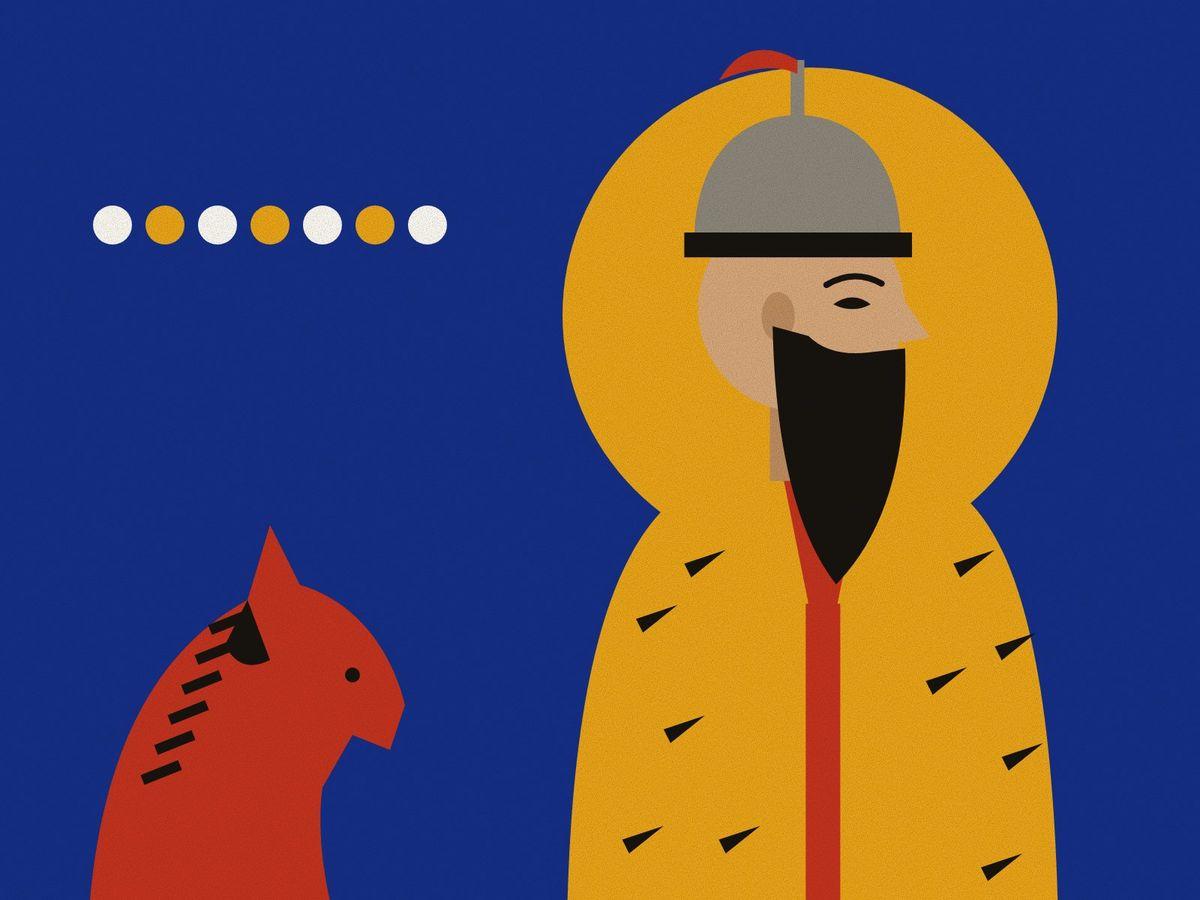
Rostam, Rakhsh and the seven labours
Iran's greatest hero and his matchless horse take the short, deadly road to rescue a foolish king: a lion, a desert, a dragon, a witch and the White Div.
More from the heroic ageشاهنامه
Mount Alborzالبرز کوه
On the heights of the Alborz the Simorgh raises Zal, the white-haired child his father abandoned. The poem's Alborz is a mountain at the edge of the world, traditionally identified with the range north of Tehran.
Kabulکابل
Kabul frames the life of Rostam. His mother Rudabeh is a princess of Kabul, and it is in the hunting grounds of a later king of Kabul that Rostam is betrayed and killed.
Zabulistanزابلستان
Zabulistan is the realm of the house of Sam: the court where Zal rules, Rostam is raised, and Esfandiyar comes to put Rostam in chains. Tradition places it in Sistan, around today's Zabol.
Amol and Arash's shotآمل
Amol appears in the Shahnameh as a seat of the early kings. The highlands around it, the old Tabaristan, are where medieval writers set the story of Arash the archer, whose arrow fixed the border between Iran and Turan.