Shia Islam in Iran
تشیع در ایرانTwelver Shia Islam shapes the year for most Iranians: the mourning of Muharram, the shrines of Mashhad and Qom, the shared food of a vow fulfilled.
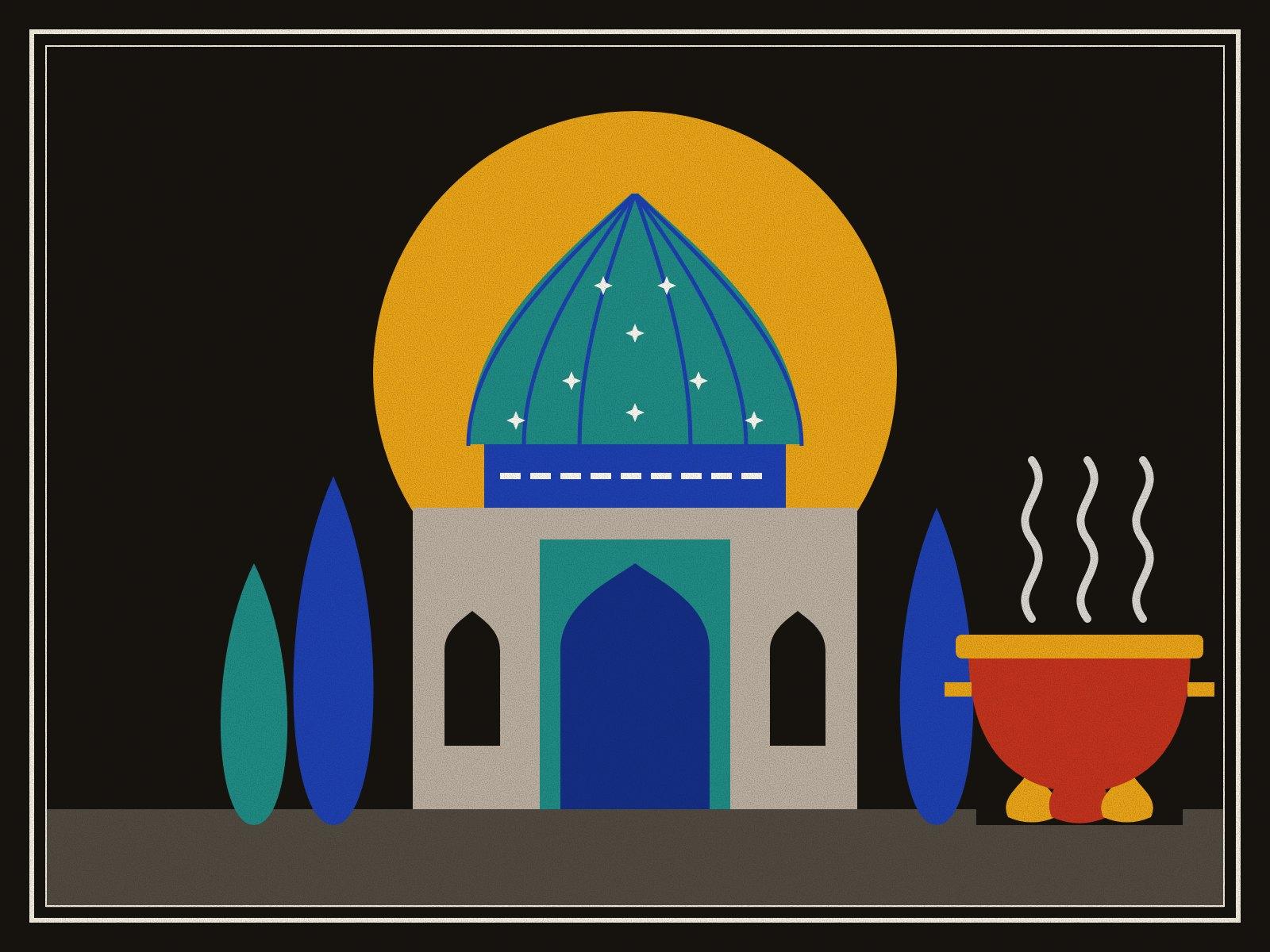
Most Iranians are Twelver Shia Muslims, called in Persian Shi’eh-ye Esna-’ashari or simply Shi’eh. Shia Islam holds that leadership of the Muslim community after the Prophet Muhammad passed to his cousin and son-in-law Ali, and then to a line of Ali’s descendants, the Imams. Twelvers recognise twelve. The twelfth, Muhammad al-Mahdi, is believed to be in occultation, hidden from the world and still alive, and to return at the end of time. Shia Islam has deep roots in Iran, in Qom and in parts of Khorasan from the early centuries, but it became the faith of most Iranians after Shah Ismail I made it the religion of the Safavid state in 1501.
Religious guidance comes through the ulama, the learned, and especially the senior jurists, each a marja’-e taqlid, a ‘source of emulation’ whom believers follow on matters of practice. The great seminaries of Qom, and across the border in Najaf, train students from across the Shia world. The faith is also lived far from them: among the Hazaras of Afghanistan, in the Republic of Azerbaijan, where most believers are Shia, and among Iranians everywhere.
Muharram and Ashura
The emotional heart of the year is Muharram. On the tenth day, Ashura, in 680 CE, Husayn, son of Ali and grandson of the Prophet, was killed with his small company at Karbala in Iraq by the army of the caliph Yazid. For Shia Muslims Husayn’s stand is the model of choosing justice at any cost. Every year, in the first ten days of the month, neighbourhoods hang black cloth and gather in hosseiniyehs and tekyehs. Preachers recite the story of Karbala in a form called rowzeh-khani, named after Kashefi’s Rowzat al-shohada. Processions of dasteh walk the streets, beating their chests in rhythm to elegies, nowheh. In Yazd and other towns a great wooden nakhl is carried in memory of Husayn’s bier. Families cook nazri, food vowed to God, and give it away: gheymeh stew, rice and the saffron pudding sholeh-zard.
The most Iranian of these traditions is ta’zieh, the passion play of Karbala, staged in courtyards and on village squares with Husayn’s party dressed in green, his enemies in red, and the opposing sides singing and speaking their parts. In 2010 UNESCO inscribed the ritual dramatic art of ta’zieh on its Representative List of the Intangible Cultural Heritage of Humanity.
For Shia Muslims Husayn’s stand is the model of choosing justice at any cost.
The road to the shrine
Pilgrimage, ziyarat, gives shape to journeys across the country. In Mashhad, millions visit the shrine of Imam Reza, the eighth Imam, who died at Tus in 818; he is the only one of the Twelve buried in Iran, and the city takes its name, ‘place of martyrdom’, from him. In Qom the shrine of his sister Fatemeh Ma’sumeh, who died there in 816, drew the scholars who made the city a centre of learning. Shiraz has Shah Cheragh, Rey has Shah Abdol-Azim, and nearly every town has an emamzadeh, the tomb of a descendant of an Imam, often a blue dome among trees. At Mashhad-e Ardehal near Kashan, a carpet is washed each autumn in memory of a martyred descendant of the Imams, a rite UNESCO inscribed in 2012.
Devotion also runs through poetry. Mohtasham Kashani’s sixteenth-century elegy for Karbala is still recited in Muharram, and Shahriar’s ghazal to Ali, Ali ey homa-ye rahmat, is sung across the country. The faith is lived in ordinary days too: the sofreh laid for a vow, a whispered ya Ali as someone lifts something heavy, the greeting of eid at Ghadir, when Shia Muslims remember the Prophet naming Ali as his successor.
Across Cultureپیوندها
Peoples
Hazaras
The Hazaras of central Afghanistan speak Hazaragi, a form of Persian, and are mostly Shia. Their homeland holds Bamiyan and Band-e Amir; their diaspora reaches Mashhad, Quetta and Australia.
More from Faithsدینها
Zoroastrianism
Good thoughts, good words, good deeds: the faith of Zarathushtra, kept by its followers in Yazd, Kerman, Tehran, Mumbai and far beyond.

Mithra and the old Iranian gods
Before and beside Zarathushtra stood older Iranian divinities: Mithra of the covenant, Anahita of the waters, Verethragna of victory. Their names survive in hymns, festivals and children.

Manichaeism
Mani, born in Sasanian Mesopotamia in 216 CE, founded a faith of light and darkness that reached from Roman Africa to the coast of China, and left Persian a proverbial painter.