Martichora
مردخوارThe man-eater with a human face and a tail of stings, described by a Greek doctor at the Persian court, whose Persian name became the European manticore.
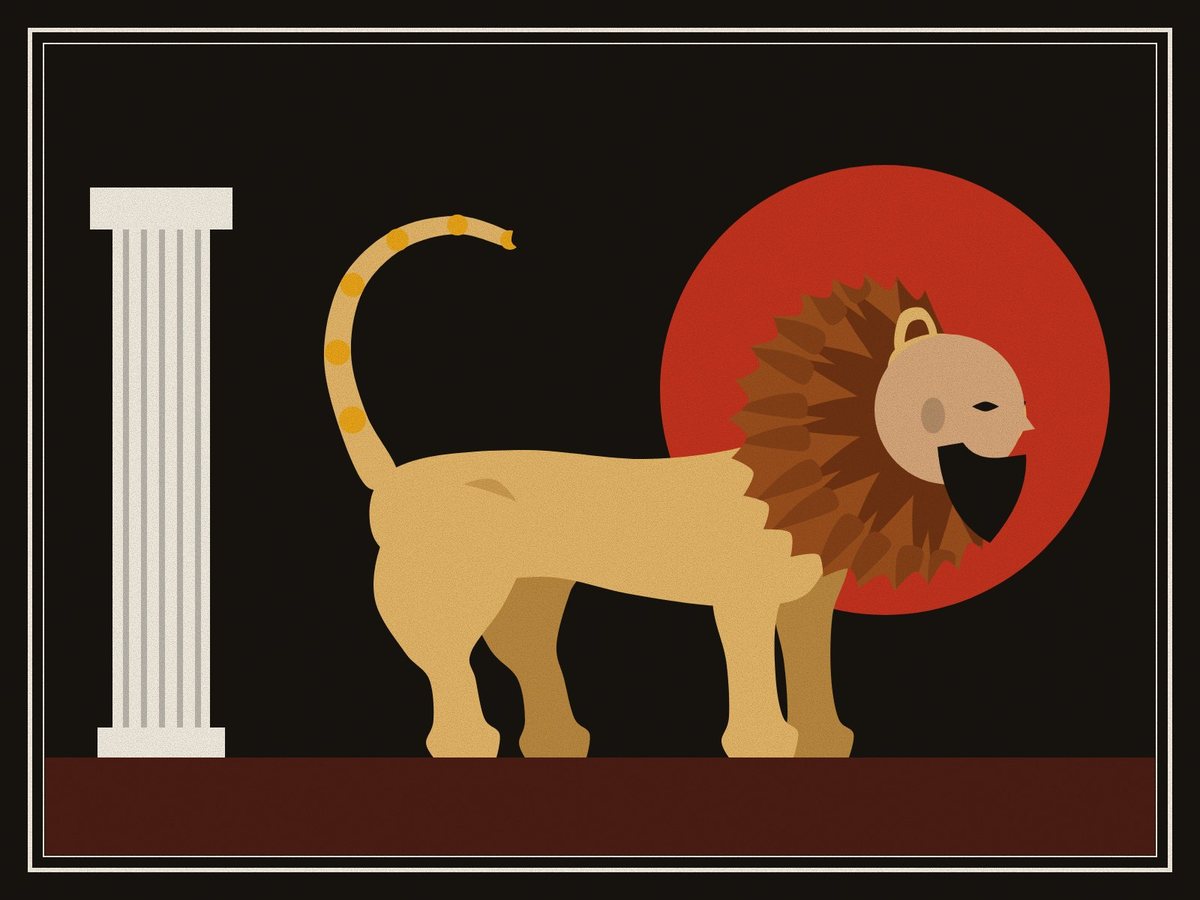
In the late fifth century BCE a Greek physician named Ctesias of Cnidus served at the Achaemenid court, attending King Artaxerxes II. Among the books he wrote was an account of India, built from what he heard from Persian-speaking travellers and officials. It survives only in fragments quoted by later writers, but one of its creatures has had an astonishing career. Ctesias called it the martichora and explained that the name meant "man-eater". Scholars agree that it renders an Old Persian compound, martiya- "man" with a verb "to eat", the same pairing found in the later Persian mardkhvār.
The beast he described is the size of a lion and red as cinnabar. It has a man's face and ears, blue-grey eyes and three rows of teeth. Its tail carries stings like a scorpion's, which it can shoot like arrows at hunters near and far. The Roman-era writer Aelian reports Ctesias's claim to have seen one himself, brought to the Persian king as a gift from India.
A man's face, three rows of teeth and a tail of stings.
From Persia to Europe
Greek copyists mistook the word, and in a faulty manuscript of Aristotle it became mantichoras. Through Pliny and the medieval bestiaries the manticore spread across Europe, a heraldic monster far from its origins. Ancient readers already doubted it: the traveller Pausanias thought Ctesias had been told a frightened exaggeration about the tiger, and many modern scholars agree.
The martichora is less a creature of Iranian folk belief than of the Achaemenid court's view of its distant provinces, but it is a reminder that some of Europe's monsters came by way of Persian words. The Atlas pin marks Susa, one of the royal residences where Ctesias lived and worked.
More from Folk creaturesموجودات افسانهای
Al
A female being said to haunt women in the days after childbirth, feared across Iran and among its neighbours, and kept at bay with iron, onion and company.
Div
Once a word for gods, the div became the great demon of Iranian story: an enemy of order in the Avesta, a captive scribe in the Shahnameh, and a horned giant in grandmothers' tales.
The White Div
The lord of the divs of Mazandaran, who blinded a king and his army, and whose blood restored their sight after Rostam killed him in his cave.