Karkadann
کرگدنThe one-horned beast of Persian and Arabic natural history, part rhinoceros and part unicorn, hunted by Bahram Gur in India and painted with endless imagination.
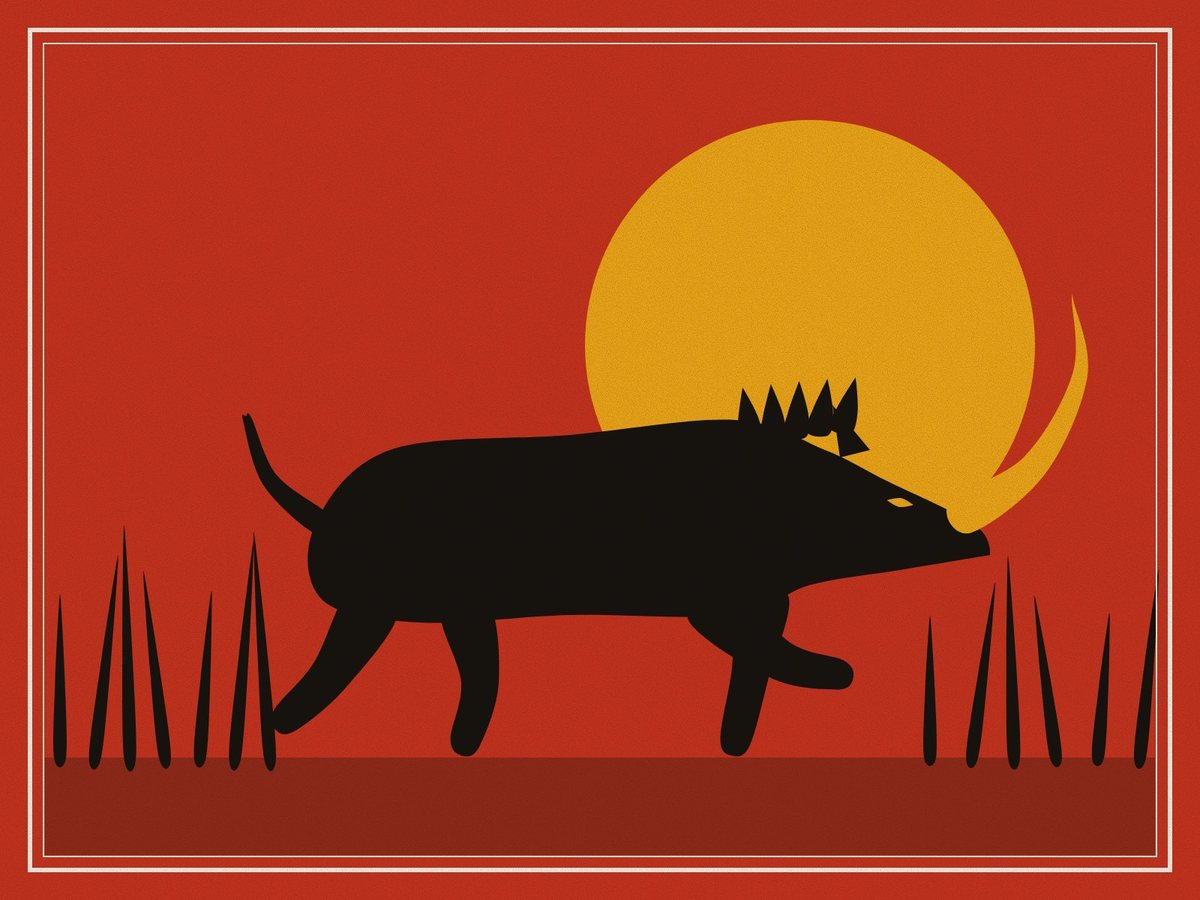
In modern Persian kargadan simply means rhinoceros. In medieval Persian and Arabic writing, karkadann was something larger and stranger: a fierce one-horned beast of India and Africa, told of in books of natural history and marvels and painted in manuscripts with a fantastic variety of bodies. The art historian Richard Ettinghausen, in a classic study of 1950, traced how the real Indian rhinoceros and older legends of the unicorn met in this one creature.
Some writers knew the real animal well. Al-Biruni, who spent years in north-western India with the Ghaznavid court in the eleventh century, described the Indian rhinoceros with care in his book on India. Others filled out the karkadann with marvels: a horn that could reveal poison, a temper so violent that it would attack even elephants, and, in some accounts, an odd friendship with a single kind of bird that it allowed to perch on its horn.
The real Indian rhinoceros and older legends of the unicorn met in this one creature.
Bahram Gur's hunt
The Shahnameh gives the karkadann's cousin a starring role. When the Sasanian king Bahram Gur visits India in disguise, the Indian ruler Shangal sets him tasks, among them killing a monstrous karg that terrorises the land. The word is often translated as rhinoceros, but painters of the Shahnameh had seldom seen one. They gave Bahram's karg the body of a wolf, a horse or a bull, always with a single great horn, and the scene became one of the favourite set pieces of Persian painting.
The Atlas pin marks Ghazni, the Ghaznavid capital from which writers such as al-Biruni looked towards India, and from which much of what Persian readers learned about the karkadann first came.
More from Folk creaturesموجودات افسانهای
Al
A female being said to haunt women in the days after childbirth, feared across Iran and among its neighbours, and kept at bay with iron, onion and company.
Div
Once a word for gods, the div became the great demon of Iranian story: an enemy of order in the Avesta, a captive scribe in the Shahnameh, and a horned giant in grandmothers' tales.
The White Div
The lord of the divs of Mazandaran, who blinded a king and his army, and whose blood restored their sight after Rostam killed him in his cave.