Haftvad's worm
کرم هفتوادA tiny worm found in an apple that grew into a monster in a fortress, made its keeper rich and powerful, and was finally killed by Ardashir with molten metal.
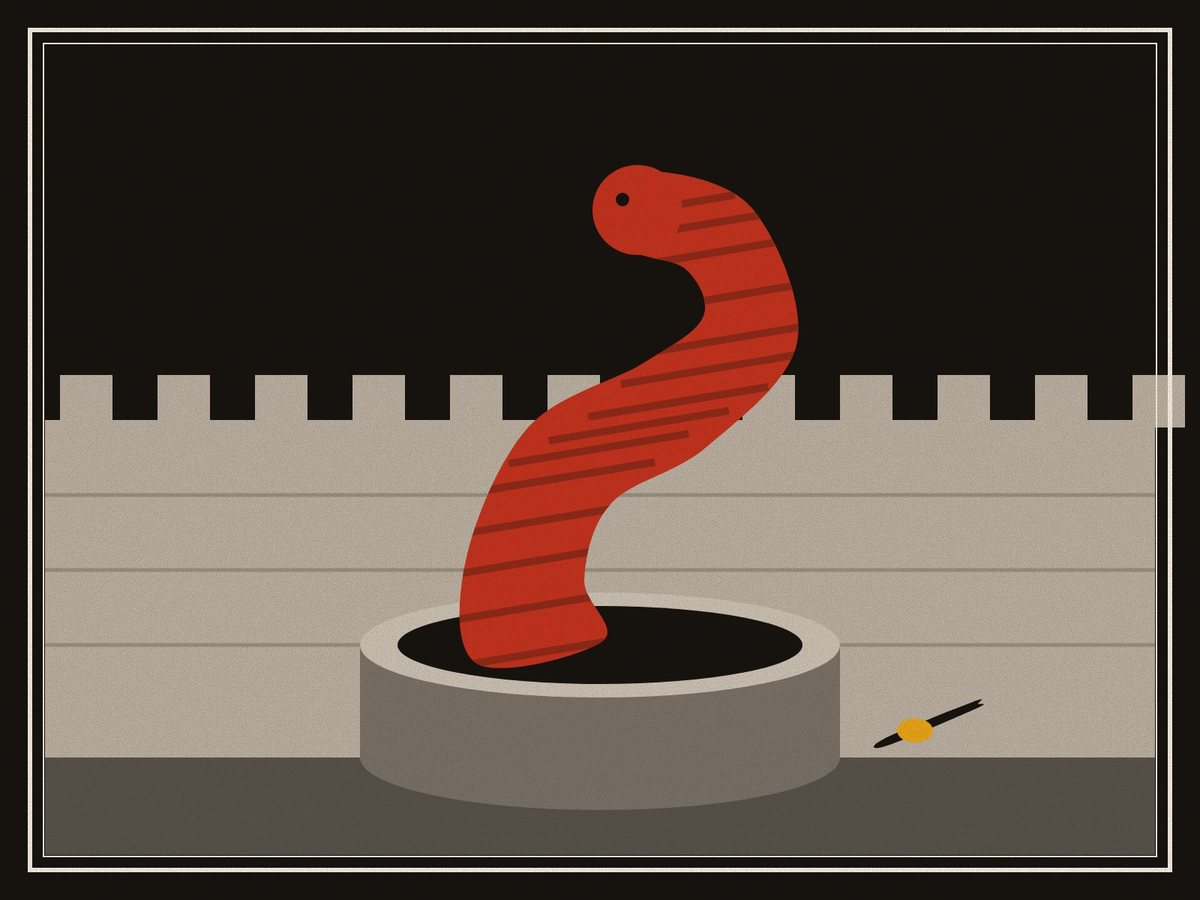
Among the stories of the founding of the Sasanian dynasty, one of the strangest concerns a worm. In Ferdowsi's Shahnameh, a poor man named Haftvad lives in a town on the shore of the sea in Pars with his seven sons and a daughter. One day the girl, spinning cotton with other girls, bites into an apple and finds a small worm inside. She keeps it on her spindle as a charm, and that day she spins twice as much as before. Luck follows the worm. The family grows rich, Haftvad gathers followers, and the worm, fed and tended, grows enormous.
Haftvad builds a fortress on a mountain, and the worm is kept there in a great cistern, with servants to feed it. Its keepers grow so powerful that they defeat Ardashir, the first Sasanian king, in battle. Ardashir returns in disguise as a merchant, wins over the worm's keepers with gifts and wine, and pours molten metal into the creature's mouth. The worm bursts with a sound that shakes the fortress, and Haftvad's power collapses.
She keeps it on her spindle as a charm, and that day she spins twice as much as before.
What was the worm?
The story is older than Ferdowsi. The Middle Persian Kārnāmag ī Ardaxšīr ī Pābagān, "The Book of the Deeds of Ardashir", tells a version in which the creature is called the worm of Kerman and its master Haftānbōxt. Scholars have long wondered what lies behind it. Some see a memory of a local cult that the Sasanians suppressed, others a story about silk and spinning wealth, others an image of rebellious local power. None of these readings is proven, and the tale works as a fable on its own.
The Atlas pin marks Kerman, the region named in the Kārnāmag. Ferdowsi's town lies by the sea, and its exact site is uncertain.
In the Shahnamehشاهنامه
More from Folk creaturesموجودات افسانهای
Al
A female being said to haunt women in the days after childbirth, feared across Iran and among its neighbours, and kept at bay with iron, onion and company.
Div
Once a word for gods, the div became the great demon of Iranian story: an enemy of order in the Avesta, a captive scribe in the Shahnameh, and a horned giant in grandmothers' tales.
The White Div
The lord of the divs of Mazandaran, who blinded a king and his army, and whose blood restored their sight after Rostam killed him in his cave.