Gopatshah
گوپتشاهA ruler who is a man from the waist up and an ox below, who sits by the water pouring offerings and keeps the ox whose fat will make the world immortal.
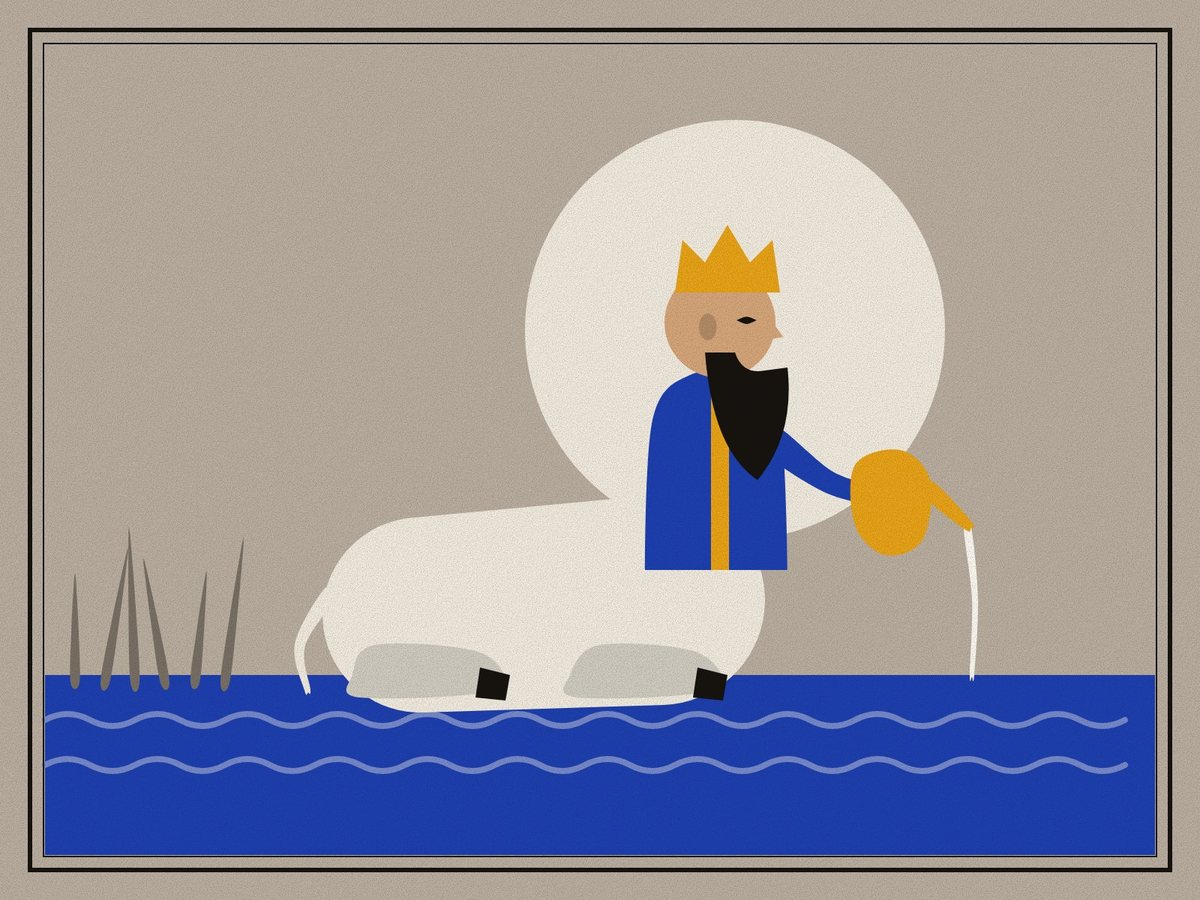
Gopatshah, Middle Persian Gōbadšāh or Gōpatšāh, is one of the most curious figures of the Zoroastrian tradition. The Mēnōg ī Xrad, "The Spirit of Wisdom", a Middle Persian book of questions and answers, describes him: from his feet to his middle he is an ox, and from his middle upwards he is a man. He sits always beside a body of water, worshipping the gods and pouring libations into it, and by that offering countless harmful creatures in the water are destroyed.
The same text calls him the ruler of the people of Ērānwēz, the first homeland of the Iranians in Zoroastrian tradition, and the Bundahishn places his land beside it. He is counted among the immortal rulers of the mythic world, who will help bring about the final renewal of creation.
From his feet to his middle he is an ox, and from his middle upwards he is a man.
Keeper of the last ox
In the account summarised in the Encyclopaedia Iranica, Gopatshah also keeps the ox Hadayans, also known as Sarsaok, in a fortress of metal. In Zoroastrian lore this is the ox on whose back the first people crossed the sea to settle the other regions of the earth. At the end of time its fat will be used, with the white Hom, in the last great ceremony to make the elixir of immortality for the risen dead. Gopatshah is therefore a guardian of the future as well as a priest of the present.
Iranian art historians have compared him with the human-headed bulls of Mesopotamian and Achaemenid art, such as the guardians of the Gate of All Nations at Persepolis, though those have a human head on a bull's body rather than his half-and-half form. The Atlas places him in Khwarazm, one of the regions scholars have proposed for Ērānwēz; the identification is debated.
Across Cultureپیوندها
Mythology
Ahura Mazda and Ahriman
The Wise Lord and the Hostile Spirit: the oldest Iranian account of a world in which every person takes a side, and the moral heart of a faith still practised today.
More from Folk creaturesموجودات افسانهای
Al
A female being said to haunt women in the days after childbirth, feared across Iran and among its neighbours, and kept at bay with iron, onion and company.
Div
Once a word for gods, the div became the great demon of Iranian story: an enemy of order in the Avesta, a captive scribe in the Shahnameh, and a horned giant in grandmothers' tales.

The White Div
The lord of the divs of Mazandaran, who blinded a king and his army, and whose blood restored their sight after Rostam killed him in his cave.