Arabic in Iran
عربی در ایرانArabic is spoken as a mother tongue in Khuzestan and along the Gulf coast, recited in every mosque, and woven so deeply into Persian that no sentence of literary Persian is free of it.

In Ahvaz, Shadegan, Hoveyzeh and Khorramshahr, many families speak Arabic at home. Iran’s Arabs, who call themselves ‘Arab and some of whom call their region al-Ahwaz, live mainly in Khuzestan, in the lowlands at the head of the Gulf, with smaller communities along the coasts of Bushehr and Hormozgan and in a few villages of Khorasan. Their spoken Arabic is closely related to the dialects of southern Iraq, across the Shatt al-Arab, and the tribal ties between the two sides of the border are old ones.
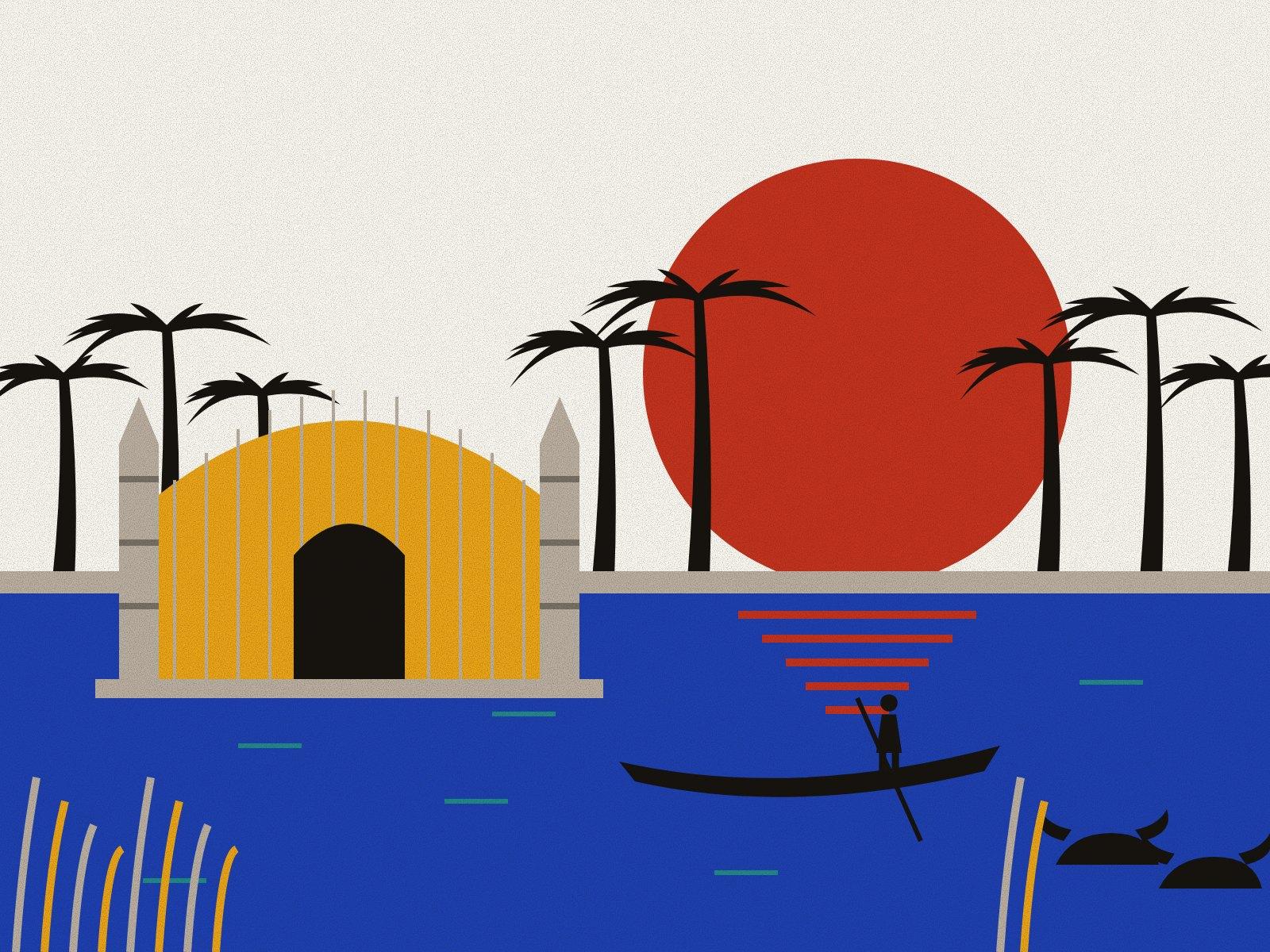
Arab culture in Khuzestan is rich in poetry and song: tribal verse, the chanted hosa of celebrations and mourning, and wedding songs and dances. The marshes of Hoveyzeh, the palm groves along the Karun and Arvand rivers and the buffalo herders of the wetlands are part of the same world as the marshes of southern Iraq. Most Iranian Arabs are Shia Muslims, and the Muharram rituals of Khuzestan are among the most intense in Iran.
The language of scripture and scholarship
For all Iranians, Arabic is also the language of the Quran and of prayer, and Iran’s constitution provides that it be taught in all classes of secondary school. For centuries after the Arab conquest, Arabic was the main language of scholarship across the Iranian world, and many of its great writers were Iranians: Sibawayh, from near Shiraz, wrote the founding grammar of Arabic; Avicenna, al-Biruni, al-Razi and al-Tabari wrote mostly in it.
Arabic inside Persian
Persian took the Arabic script and a vast number of Arabic words, especially in religion, law, learning and abstract thought: ketāb ‘book’, eshq ‘love’, fekr ‘thought’. These words were Persianised in sound and often in meaning, and they are combined with Persian verbs as if they had always belonged there. Poets used the mixture with relish. Saadi wrote poems in Arabic as well as Persian, and the very first ghazal in Hafez’s Divan opens with a line of Arabic: alā yā ayyuhā s-sāqī adir ka’san wa-nāwilhā, ‘O cupbearer, pass round the cup and hand it on’. Over the last century, some Iranian writers and the Academy of Persian Language and Literature have favoured Persian coinages over Arabic words, while others see the Arabic layer as an inseparable part of the language.
Poets used the mixture with relish.
Arabic-speaking Iranians have experienced documented discrimination. Amnesty International, Human Rights Watch and UN special rapporteurs have reported restrictions on education in Arabic, the confiscation of land, and the arrest and execution of Ahvazi Arab activists, particularly after protests in 2005. Khuzestan also suffered heavily in the Iran–Iraq War of 1980–88, in which Iranian Arabs fought and died on Iran’s side. Through all of it, Arabic remains a living language of home, poetry and faith in the south-west of the country.


Across Cultureپیوندها
Peoples
Arabs of Iran
Iran’s Arabs live mainly in Khuzestan and along the Gulf coast. Their Arabic dialects, tribal poetry, coffee and date palms are as old in Iran as any city on the plain.
More from Languagesزبانها

Persian
Spoken in Tehran, Kabul and Dushanbe under three names and written in two alphabets, Persian is one language with three national standards and a thousand years of shared poetry.

Old Persian and the cuneiform inscriptions
Carved into cliffs and palace walls in a script of wedges, Old Persian is the oldest recorded form of the Persian language, and the key that unlocked the cuneiform world.

Avestan
Known only from the sacred texts of Zoroastrianism, Avestan is one of the two oldest recorded Iranian languages, and it is still recited daily in fire temples in Yazd, Tehran and Mumbai.