The Shahnameh atlas · The mythical age · The reign of Fereydun
Fereydun divides the world among his sons
بخش کردن جهان میان پسران فریدونThree brothers marry three sisters of Yemen and receive Rum, Turan and Iran
Fereydun crowns himself on the first day of Mehr, and the people hold a new festival, with wine and fires of ambergris and saffron. Keeping Mehregan was his custom, Ferdowsi says, and the month of Mehr is his memorial. His mother, Faranak, gives her treasure away to the poor in secret. Then the new king travels the world, putting right whatever is unjust and planting cypress and rose where grass once grew. From Amol he goes on to Tamisheh and settles in its famous wood.
When he is fifty he has three sons, tall as cypresses: two by Shahrnaz, and the youngest by Arnavaz. They still have no names. Fereydun sends his trusted man Jandal around the world to find them three sisters of royal blood, alike in looks. Jandal finds them in Yemen, the daughters of King Sarv. Sarv is dismayed. To lose his daughters would turn his days to night, but he dare not refuse the king who overthrew Zahhak. His nobles advise him to ask for something hard, so he answers that the three princes must come to Yemen themselves.
Fereydun prepares his sons. The king of Yemen is shrewd, he warns them; listen carefully and answer wisely. The three ride to Yemen, where the people pour out to meet them, scattering jewels and saffron and mixing musk with wine. Sarv brings out his three daughters and gives them to the princes, then sends them home with litters glittering with the gems of Yemen.
Some texts of the poem, including the one the Warners translated, add two tests here. Sarv, a sorcerer, sends a killing frost against the princes as they sleep, and they withstand it. On the road home Fereydun meets them in the shape of a fire-breathing dragon. The eldest flees, the second draws his bow, and the youngest stands his ground and warns the beast off in his father's name. From these answers Fereydun names them Salm, Tur and Iraj.
Three kingdoms
Then Fereydun brings his hidden plan into the open and divides the world in three. To Salm, the eldest, he gives Rum and the West; Salm takes the throne there and is called lord of the West. To Tur he gives Turan and makes him master of the Turks and of Chin, and the nobles of Turan scatter jewels over him. Last comes Iraj, and his father chooses him for Iran: Iran and the plain of the spear-carrying horsemen, with the royal throne and the crown of chiefs, because he is worthy of them. The three brothers settle in peace, each a noble lord of his own lands.
Iran and Turan, the two powers whose wars fill so much of the poem, begin here as the inheritances of two brothers.
Iran and Turan, the two powers whose wars fill so much of the poem, begin here as the inheritances of two brothers. Readers have long seen the seed of the tragedy that follows in this one choice: to give the heart of the world to the youngest son.
From the poemاز شاهنامه
Ferdowsi's words, with the English of Arthur and Edmond Warner's translation (1905–1925).
از آمل گذر سوی تمیشه کرد
نشست اندر آن نامور بیشه کرد
He reached Tammisha, passing by Amul,
And built a seat there in the famous chace:
یکی روم و خاور دگر ترک و چین
سیم دشت گردان و ایرانزمین
And made three realms: he joined Rum with the West,
Turan with Chin, Arabia with Iran.
از ایشان چو نوبت به ایرج رسید
مر او را پدر شاه ایران گزید
Came last, the sire selected all Iran
For him.
In Mythologyاسطوره
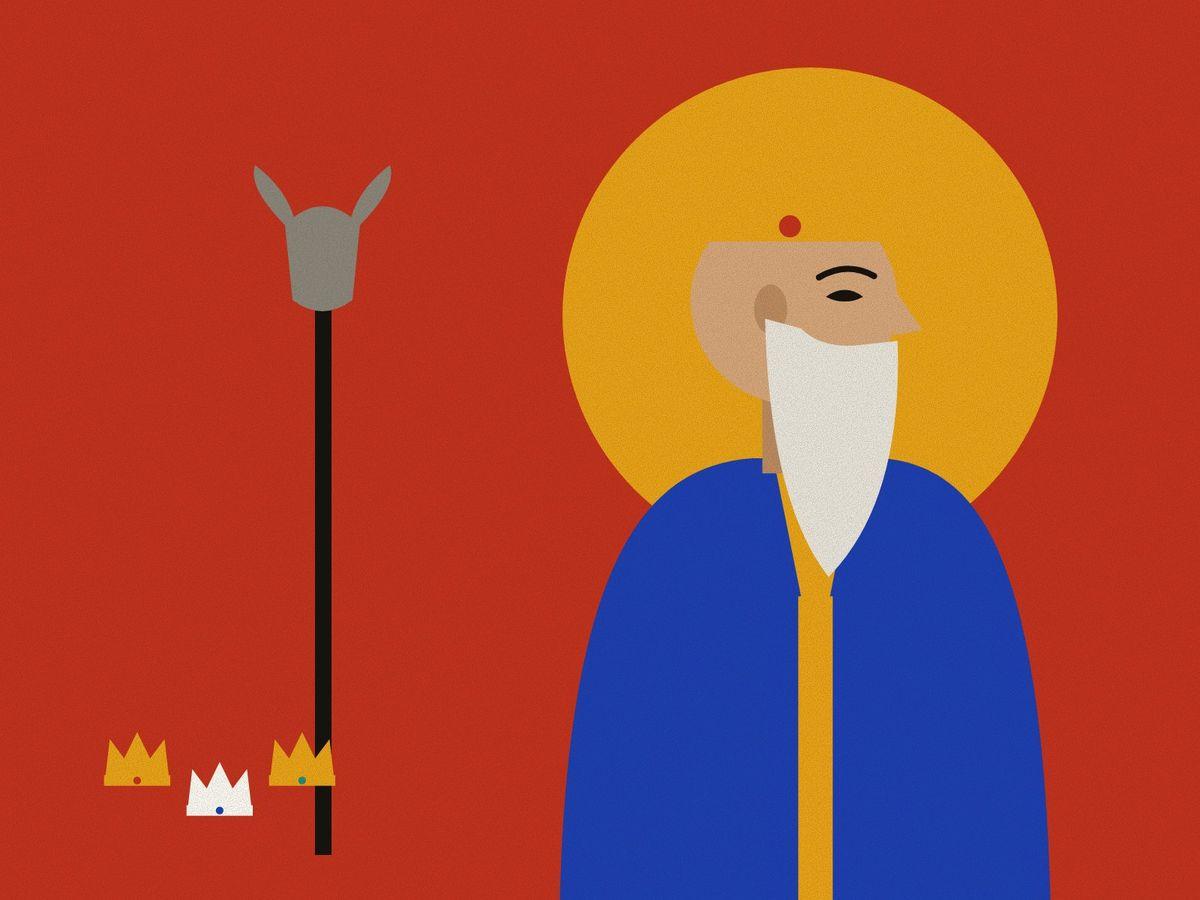
Fereydun and his three sons
The king who freed Iran from Zahhak divided the world between his sons, and in doing so, Ferdowsi says, began the long feud between Iran and Turan.