The Shahnameh atlas · The mythical age · The reign of Fereydun
The murder of Iraj
کشته شدن ایرجThe youngest brother offers up his crown in peace, and his brothers kill him
Years pass, and Fereydun grows old. Salm's heart begins to stir. Greed fills it, and he cannot accept his father's division, which gave the golden throne to the youngest son. He sends a message to Tur. We were three sons, he writes, and the youngest has risen above us; if the crown is not mine as the eldest, it should at least be yours. The message fills Tur's empty head with wind. Our father cheated us when we were young, he replies; he planted this tree with his own hand, and its water is blood.
The brothers meet and send a priest to Fereydun with a hard message. You never had the fear of God, they tell him; you shared out the world crookedly, raising one son to the clouds and feeding the others to the dragon. Take the crown from Iraj and give him a corner of the world, or we will bring the horsemen of the Turks, Chin and Rum and destroy Iran and Iraj with it.
Fereydun answers with fury and grief. He divided the world in truth and in the fear of God, he says. Whoever sells his brother for dust deserves to be called base-born. Then he calls Iraj. Your brothers want war, he tells him. Make ready and open the treasury. Take your breakfast of them before they make their supper of you.
Iraj will not have it. 'Time passes over us like the wind,' he says. 'In the end our bed is dust and our pillow a brick. Why plant a tree today whose fruit will be vengeance?' He will go to his brothers alone, without an army, and win their hearts with kindness. His father fears he is putting his head in a dragon's mouth, but lets him go, with a letter asking the elder brothers to treat the youngest gently and send him home.
Why plant a tree today whose fruit will be vengeance?
Salm and Tur ride out to meet him. Their soldiers cannot take their eyes off Iraj, and whisper that he alone is fit for the crown. Salm sees it, and that night the brothers lay their plan. At dawn they come to Iraj's tent. 'Why should you, the youngest, have Iran,' Tur demands, 'while I stand girded at the gate of the Turks?' Iraj answers: 'I want neither Iran nor the West nor Chin. I give you the crown and the seal. Do not hate me.'
Tur is not moved. He seizes the heavy golden chair and strikes Iraj with it. Iraj begs for his life. Have you no fear of God, he asks, no shame before our father? Do not make yourself a murderer. Without a word, Tur draws a dagger and stabs him, then cuts off his head. The brothers fill it with musk and ambergris and send it to Fereydun with a message: here is the head of your favourite; give him the crown now. Then one goes back to Rum and the other to the Turks.
Fereydun has a turquoise throne ready for his son's return. The army is out to greet him with drums and wine when a rider comes out of the dust with a golden casket. Inside, wrapped in silk, is the head of Iraj. Fereydun falls from his horse. He carries the head to Iraj's garden, sets fire to the house, tears up the roses and burns the cypresses, and prays to live long enough to see someone of Iraj's blood take vengeance. He weeps until grass grows around him and his eyes go dark.
From the poemاز شاهنامه
Ferdowsi's words, with the English of Arthur and Edmond Warner's translation (1905–1925).
چو بستر ز خاکست و بالین ز خشت
درختی چرا باید امروز کشت
Since then our couch is dust, our pillow brick,
Why plant to-day a tree whose roots will ever
Be drinking blood, whose fruit will be revenge?
من ایران نخواهم نه خاور نه چین
نه شاهی نه گسترده روی زمین
I do not want Iran, the West, or Chin,
The kingship or the broad expanse of earth.
فرود آمد از پای سرو سهی
گسست آن کمرگاه شاهنشهی
The lofty Cypress
Fell, the imperial girdlestead was broken,
In Mythologyاسطوره
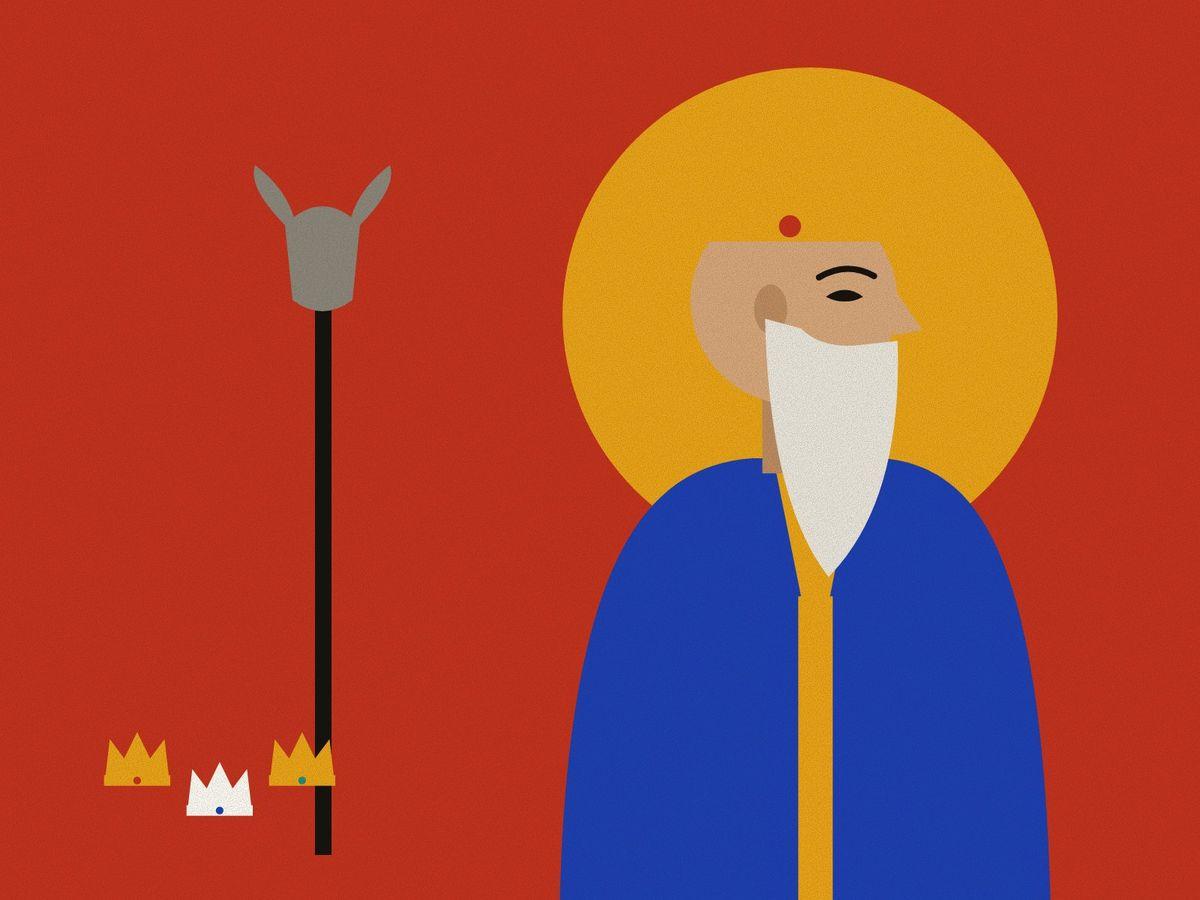
Fereydun and his three sons
The king who freed Iran from Zahhak divided the world between his sons, and in doing so, Ferdowsi says, began the long feud between Iran and Turan.