The Shahnameh atlas · The mythical age · The reign of Zahhak
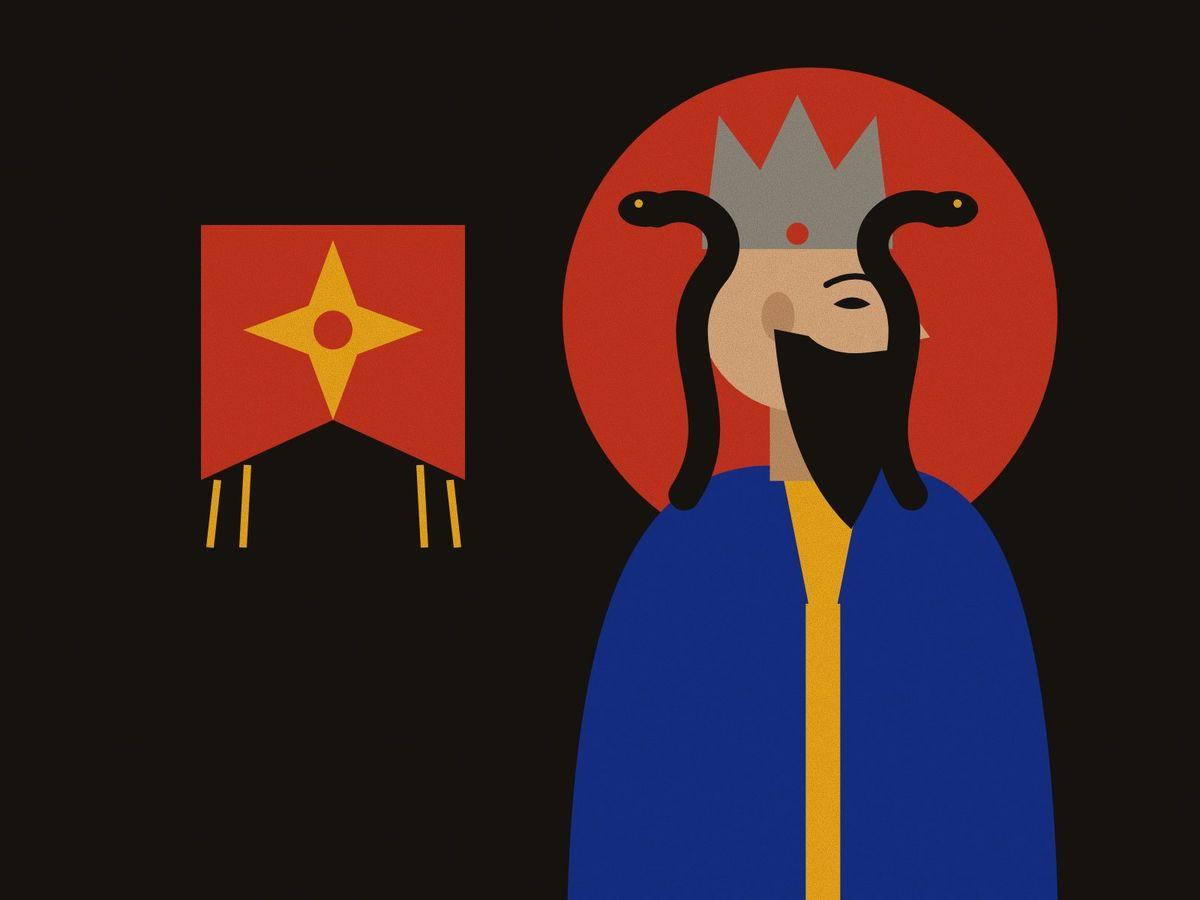
Zahhak, the king with serpents on his shoulders
ضحاک ماردوشThe devil's kiss puts two snakes on a prince's shoulders, and they must eat human brains
In the plains of the Arabs, among the spear-carrying horsemen, lives a good king named Mardas. He owns a thousand of every kind of milking animal and gives the milk freely to anyone in need. His son Zahhak is brave but rash and impure. People call him Bivarasp: in Pahlavi, the poem explains, bivar means ten thousand, and Zahhak owns ten thousand Arab horses with golden bridles.
One morning Iblis, the devil, comes to Zahhak disguised as a well-wisher and makes him swear to keep a secret. Then he speaks. Why should your old father live on while you wait? Take his place. The thought of his father's blood grieves Zahhak and he refuses, but Iblis holds him to his oath, and Zahhak gives way. In Mardas's garden there is a path the old king walks before dawn to wash and pray. Iblis digs a deep pit across it and covers it with brushwood. Mardas falls in and dies, and Zahhak puts on the crown of the Arabs.
Iblis comes back as a young cook. In those days, the poem says, there were few kinds of food. The cook feeds the king the meat of birds and beasts, to fill him with blood and make him bold as a lion: egg yolk first, then partridge and pheasant, then fowl and lamb, and on the fourth day veal with saffron, rosewater, old wine and musk. Delighted, Zahhak asks him to name his reward. The cook asks only to kiss the king's shoulders. Zahhak agrees. The cook kisses them and vanishes into the ground.
From each shoulder grows a black snake. Zahhak cuts them off, and they grow again like branches on a tree. The doctors fail. Then Iblis appears once more, dressed as a physician. 'This was fated,' he says. 'Do not cut them. Feed them and give them nothing but human brains. Perhaps that food will kill them.' Ferdowsi asks the reader to see what the devil wanted: a world emptied of people.
From each shoulder grows a black snake.
When Jamshid falls, the nobles of Iran make Zahhak their king, and he reigns for a thousand years. Wisdom hides and sorcery is honoured. Jamshid's two daughters, Shahrnaz and Arnavaz, are brought trembling to his palace and taught his crooked ways. Every night the cook kills two young men for the snakes. Two good men, Armayel and Garmayel, take service in the royal kitchen to save one of each pair: they mix one victim's brain with a sheep's and send the other away to the hills and plains. The poem says the Kurds are descended from those who were saved.
When Zahhak has forty years left, he dreams. Three warriors come out of the royal palace. The youngest, in the middle, tall as a cypress, strikes him with an ox-headed mace, ties a halter round his neck and drags him to Mount Damavand. Zahhak wakes screaming. Arnavaz tells him to call the wise men. For three days they are silent; on the fourth, threatened with the gallows, one named Zirak speaks. A man named Fereydun, not yet born, will take your throne, he says. You will kill his father and the cow that nurses him, and he will come for you with an ox-headed mace. Zahhak faints, then sends men across the world to find Fereydun.
Fereydun is born all the same. Zahhak's men catch his father, Abtin, and feed his brain to the snakes. His mother, Faranak, gives the baby to the keeper of a meadow, where a wondrous cow named Barmayeh, coloured like a peacock, feeds him for three years. When word of the cow spreads, she carries him to a holy man on Mount Alborz. Zahhak comes too late. He kills the cow and every beast in the meadow, and burns the family's house.
From the poemاز شاهنامه
Ferdowsi's words, with the English of Arthur and Edmond Warner's translation (1905–1925).
دو مار سیه از دو کتفش برست
غمی گشت و از هر سویی چاره جست
A marvel followed — from the monarch's shoulders
Grew two black snakes. Distraught he sought a cure
به جز مغز مردم مدهشان خورش
مگر خود بمیرند از این پرورش
Give them men's brains and gorge them till they sleep,
It is the only means, such food may kill them.
هنر خوار شد جادویی ارجمند
نهان راستی آشکارا گزند
All virtue was despised, black art esteemed,
Right lost to sight, disaster manifest;
In Mythologyاسطوره
Zahhak and Kaveh the blacksmith
A king with serpents growing from his shoulders, and the blacksmith who raised his leather apron on a spear and brought him down.