The Shahnameh atlas · The mythical age · The reign of Jamshid
The glory and fall of Jamshid
شکوه و فرجام جمشیدThe king who gave the world its crafts and its New Year forgets God
Jamshid, son of Tahmuras, sits on his father's throne in the crown of gold, and the whole world obeys him. Divs (demons), birds and pari (fairies) do his bidding. 'I have the divine farr,' he says, meaning the glory that God gives to rightful kings. 'I am both king and priest. I will keep the wicked from evil and lead souls towards the light.'
Seven centuries of making
He works in spans of fifty years. In the first he makes weapons, softening iron with his royal glory into helmets, mail and breastplates, swords and armour for horses. In the second he makes cloth, from linen, silk and wool to brocade and fine fabrics, and teaches people to spin and weave, to wash and to sew. In the third he divides the people into four groups, each in its place: the priests, whom he sets apart to worship on the mountains; the warriors, who guard the throne and the land; the farmers, who sow and reap their own bread and answer to no one; and the craftsmen, always busy and always thinking.
Next he sets the divs to work. They mix earth and water, shape bricks, build walls of stone and plaster, and raise bathhouses and tall palaces. Jamshid draws jewels out of the rock, rubies and silver and gold. He brings perfumes into use, camphor and musk, aloes, ambergris and rosewater. He opens the secrets of medicine, and he crosses the sea in ships from land to land.
When all this is done he builds a throne set with jewels, and the divs lift it from the ground into the sky. He sits there in mid-air, shining like the sun. The world gathers in wonder, scatters jewels over him and calls that day the New Day, the first of Farvardin and the head of the new year. The nobles hold a feast with wine and music, and Ferdowsi says that this glad festival has come down from those kings to us. Readers have always heard Nowruz in these lines.
The fall
For three hundred years no one dies. People know no pain or harm, and the divs serve like slaves. Then Jamshid looks around his throne and sees no one in the world but himself. He calls the elders. 'I know no world but myself,' he tells them. 'All skill came from me. Your food, your sleep and your ease come from me. Who says there is any king but me?' The priests bow their heads, and no one dares to answer.
Jamshid looks around his throne and sees no one in the world but himself.
As soon as the words are spoken, the farr of God turns away from him. Ferdowsi pauses for the lesson: whoever is ungrateful to God will feel fear coming at him from every side. Jamshid's day turns dark. Rebels rise across Iran, and the riders of Iran go to the Arabs, where a dragon-like king named Zahhak rules, and make him king of Iran. Zahhak takes the throne, and the world fits his finger like a ring. Jamshid gives up crown, treasure and army and disappears.
He hides for a hundred years. In the hundredth he is seen by the sea of Chin, and Zahhak seizes him and saws him in two. He had lived seven hundred years. 'What use is a long life?' the poet asks, and ends with a prayer of his own: his heart is weary of this passing inn, and he asks God to free him from its toil. Later Iranians gave Jamshid's name to the ruins of Persepolis, Takht-e Jamshid, though the poem itself does not place him there.
From the poemاز شاهنامه
Ferdowsi's words, with the English of Arthur and Edmond Warner's translation (1905–1925).
منم گفت با فرّهٔ ایزدی
همم شهریاری همم موبدی
"Mine is the Grace," he said, "I am both king
And archimage, I will restrain ill-doers
به جمشید بر گوهر افشاندند
مر آن روز را روز نو خواندند
The people scattered jewels, and bestowed
Upon the day the name of New Year's Day,
چو این گفته شد فرّ یزدان از اوی
بگشت و جهان شد پر از گفتوگوی
To answer and God's Grace departed from him,
The world was filled with din, the Court deserted,
In Mythologyاسطوره
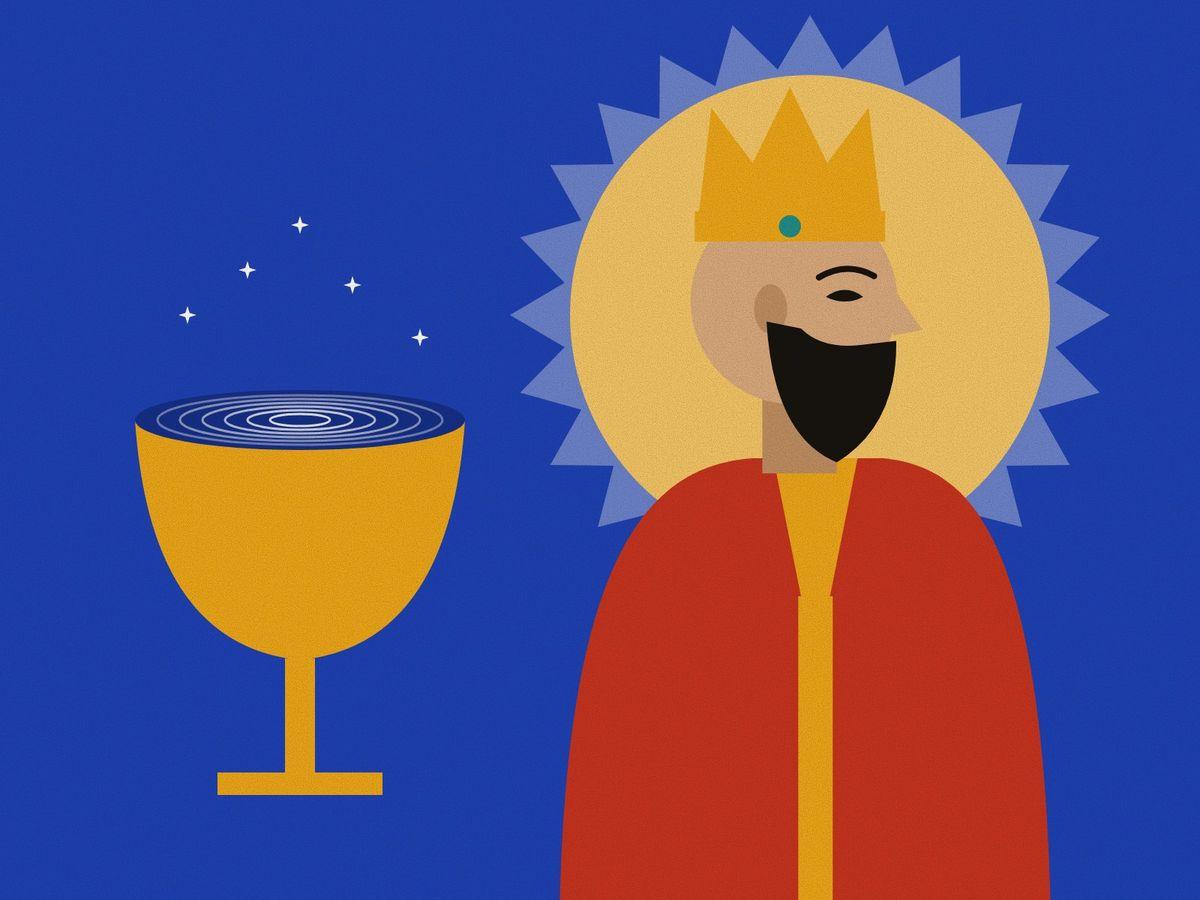
Jamshid and his cup
The brilliant king who gave his people Nowruz, then lost everything to pride. Plus the famous world-revealing cup, which belonged to someone else first.