The Shahnameh atlas · The mythical age · The reign of Zahhak
Kaveh the blacksmith
کاوهٔ آهنگرA blacksmith tears up the tyrant's charter and raises his leather apron as a banner
Zahhak cannot stop saying Fereydun's name. One day, seated on his ivory throne in a turquoise crown, he calls the nobles of every province to shore up his rule. He tells them he has a secret enemy, young but dangerous, and needs a larger army of men, divs (demons) and pari (fairies). First they must sign a mahzar, a declaration, swearing that the king has sown nothing but good and speaks only the truth. Out of fear, young and old put their names to it.
At that moment a cry for justice rises at the palace gate. The man is brought in and seated among the nobles. 'Tell us who has wronged you,' says Zahhak. The man beats his head. 'King, I am Kaveh, and I ask for justice. I am a blacksmith who harms no one, and fire keeps falling on my head from the king. You may have the body of a dragon, but you must still judge my case. If you rule the seven climes, why are all the pain and hardship ours? Show me how my turn came round, so the world can marvel: why must my son's brain be fed to your snakes?'
Zahhak is astonished. Kaveh's son is given back to him, and the king asks him kindly to add his name to the declaration. Kaveh reads it through and turns on the elders. 'You have taken the side of the div,' he shouts. 'You have set your faces towards hell. I will not be a witness to this.' He tears the declaration, tramples it and walks out with his son. The courtiers ask why the king let a blacksmith speak to him as an equal. Zahhak answers that when Kaveh came in, it was as if a mountain of iron rose between them, and he does not know what will come of it.
The banner
In the market a crowd gathers round Kaveh. He takes the leather apron that smiths wear to shield their legs at work, lifts it on a spear and calls out: whoever wants Fereydun and wants to be free of Zahhak's chains, come with me; this master is Ahriman, the enemy of God. With that worthless piece of leather, friend could be told from foe. A great crowd follows him, and Kaveh, who knows where Fereydun is, leads them straight to him.
With that worthless piece of leather, friend could be told from foe.
Fereydun sees the leather on the spear and takes it as a good omen. He decks it with brocade of Rum, with jewels and gold, sets a round like the moon at its head and hangs it with streamers of red, yellow and violet. He calls it the Derafsh-e Kaviani, Kaveh's banner. From then on every king who takes the throne hangs new jewels on the blacksmith's leather, until it shines like a sun in the dark night and gives the world hope.
Fereydun tells his mother he is going to war, and asks his two older brothers, Kianush and Purmayeh, to bring him smiths. With a compass he draws a design on the ground: a mace with the head of a buffalo. The smiths forge it, and it shines like the sun. It is the ox-headed mace of Zahhak's dream.
The banner had a life outside the poem. Early Islamic historians describe the Derafsh-e Kaviani as the great standard of the Sasanian kings, taken by the Arab armies at the battle of Qadisiyyah. Kaveh's rising is also kept in Kurdish tradition, where his victory over Zahhak is remembered at Newroz.
From the poemاز شاهنامه
Ferdowsi's words, with the English of Arthur and Edmond Warner's translation (1905–1925).
خروشید و زد دست بر سر ز شاه
که شاها منم کاوهٔ دادخواه
Smote on his head before the Shah and cried :—
"O Shah! my name is Kawa and I sue
For justice.
که گر هفت کشور به شاهی تو راست
چرا رنج و سختی همه بهر ماست؟
Since thou dost rule the seven provinces
Why should the toil and hardship all be ours?
فرو هشت ازو سرخ و زرد و بنفش
همی خواندش کاویانی درفش
With yellow, red, and violet, he named it
The Kawian flag.
In Mythologyاسطوره
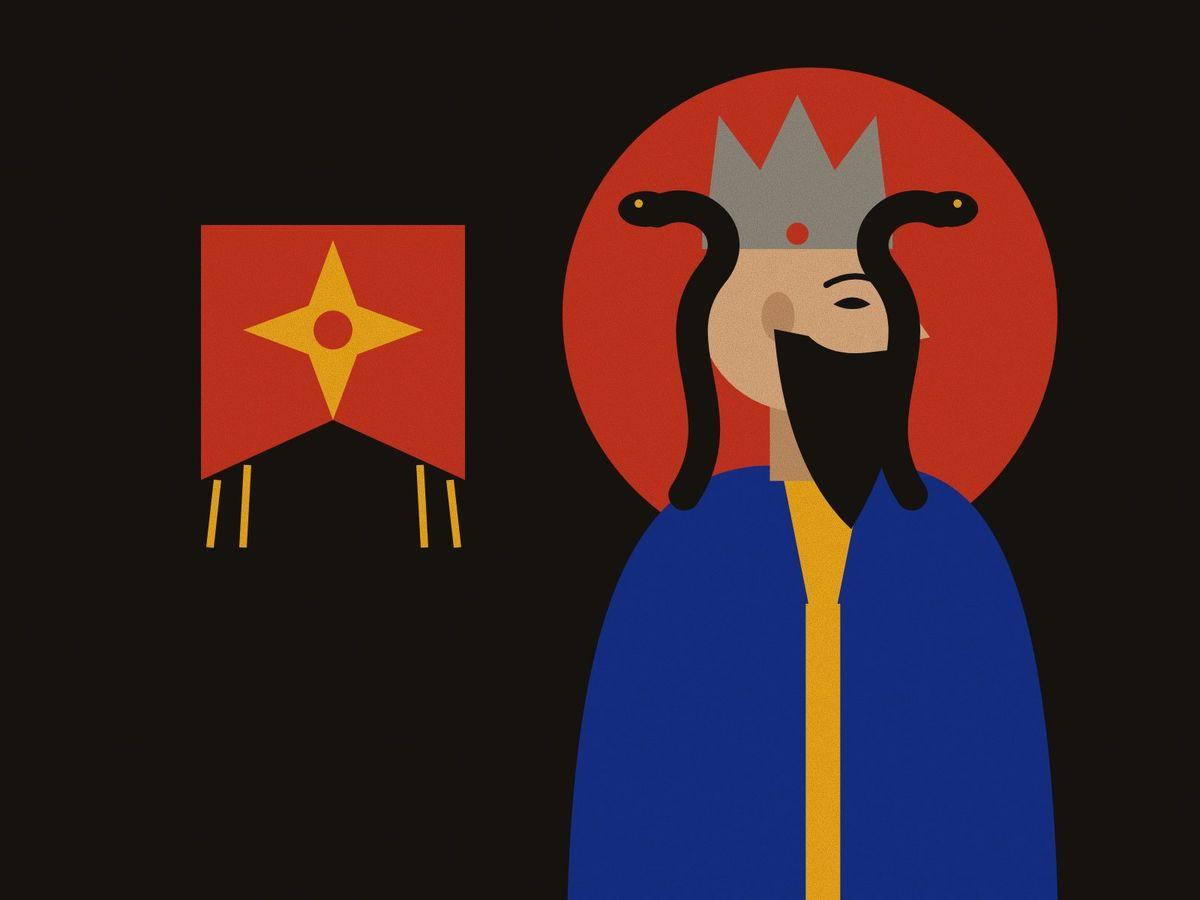
Zahhak and Kaveh the blacksmith
A king with serpents growing from his shoulders, and the blacksmith who raised his leather apron on a spear and brought him down.