The Shahnameh atlas · The heroic age · The reign of Kay Khosrow
Kay Khosrow's great war and the death of Afrasiab
جنگ بزرگ کیخسرو و افراسیابKay Khosrow pursues Afrasiab across the Jayhun and the sea, to a cave and a lake
With Piran dead, Afrasiab mourns, swears revenge and brings his last armies to the Jayhun. Kay Khosrow, enthroned on an elephant, calls up every province of Iran. Afrasiab's son Shideh brings an offer of peace, and Kay Khosrow answers that only Afrasiab's own blood will pay for Siyavash's, and that the two kings should settle it man to man. Afrasiab, troubled by a dream he has long kept secret, hangs back, but Shideh insists on meeting Kay Khosrow himself. Far from the armies they fight on foot. Kay Khosrow lifts Shideh, dashes him to the ground and kills him, then orders him a royal tomb: he was his mother's brother.
From Gang-behesht to Gang Dezh
The armies meet, and Afrasiab slips away by night across the Jayhun. Kay Khosrow follows. The people of Sughd welcome him; a fierce wind answers his prayer in the next battle, and Afrasiab shuts himself in Gang-behesht, his paradise city. His son Jahn comes with words of regret and an offer of peace, and is refused. Rostam leads the storming, throws down the black banner and raises Iran's on the wall. Garsivaz and Jahn are taken, but Afrasiab escapes by a passage under his palace. When the Iranians want revenge on his women, Kay Khosrow protects them: goodness, he says, is the memorial a man leaves in the world.
Afrasiab finds an ally in the Faghfur of Chin, attacks Kay Khosrow's camp by night, fails, and flees across the sea to Gang Dezh, the castle Siyavash built. Kay Khosrow defeats the king of Makran on the coast, takes ship and follows. The crossing takes seven months, and his soldiers point out monsters in the water: men with hair like lassos, men with buffalo heads. At Gang Dezh he dismounts and weeps at the walls his father raised, and the army weeps with him. Afrasiab has fled again. Kay Khosrow stays a year, sails back, mourns at the place in Siyavashgerd where his father was killed, and returns through Sughd and Bukhara to Iran, where he and Kay Kavus pray together at the fire of Azar Goshnasp.
At Gang Dezh he dismounts and weeps at the walls his father raised.
The cave and the lake
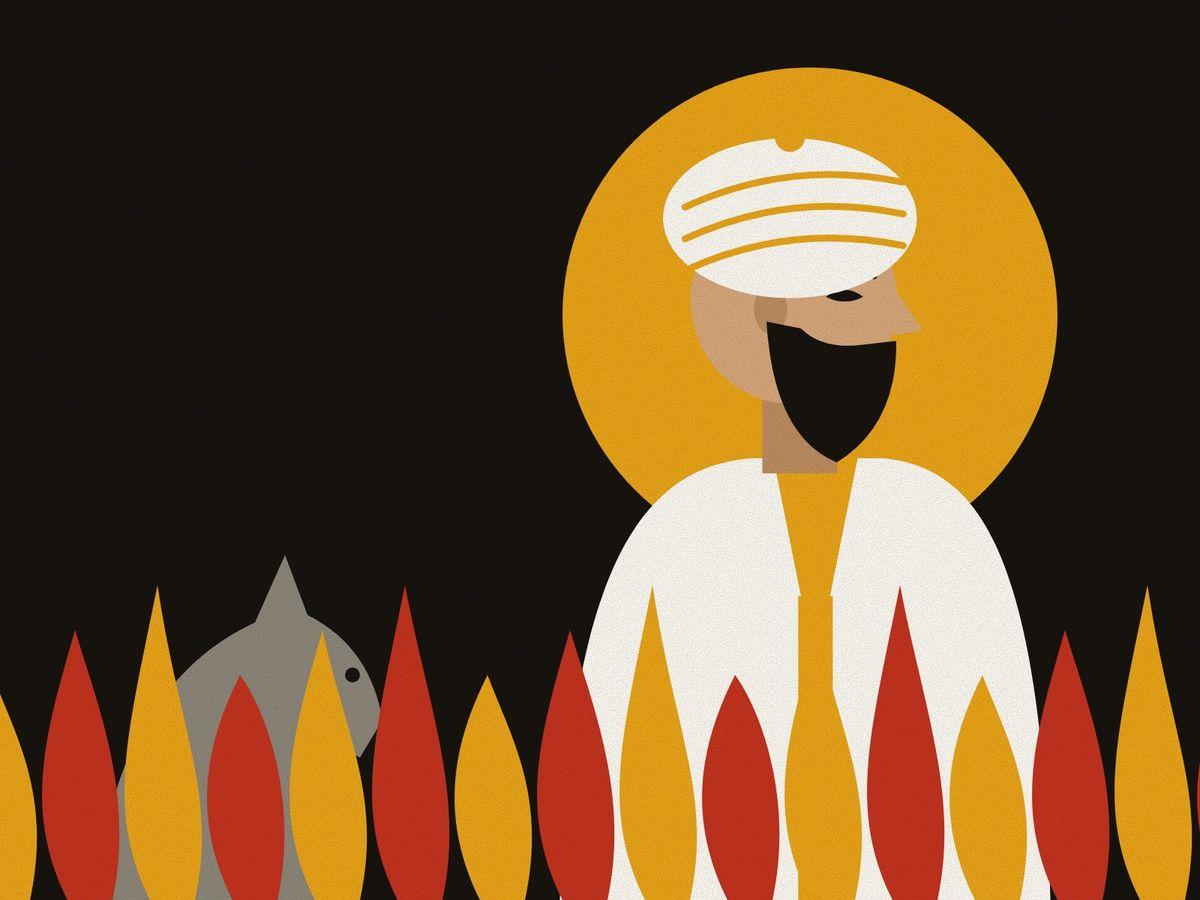
Afrasiab wanders without food or sleep and hides at last in a cave on a mountain near Barda, far from every city, which the poet says we may call the Hang of Afrasiab. On that mountain lives a holy man named Hum, of the line of Fereydun. One night he hears a voice in the cave lamenting in Turkish for a lost crown and army. He goes down, binds the king with the lasso he wears as a belt and drags him out. Afrasiab begs: he too is a grandson of Fereydun. Hum loosens the cord, and Afrasiab wrenches free and dives into the lake of Chichast.
Gudarz and Giv, passing by, find Hum staring at the water and take word to the two kings at the fire temple. Hum has a plan: sew Garsivaz into a raw ox-hide, and his brother's cries will draw Afrasiab out. Afrasiab hears and swims weeping to the shore, and Hum throws his lasso and hauls him onto dry land. Kay Khosrow comes with drawn sword. Why kill your grandfather? Afrasiab asks. Kay Khosrow names his crimes: his own brother Aghriras, King Nozar, and Siyavash, beheaded like a sheep. Afrasiab asks to see his daughter's face once more; the answer is that the day of God's retribution has come. Kay Khosrow strikes him on the neck with an Indian sword, and Garsivaz is cut in two. Then the kings ride to Azar Goshnasp and scatter gold on the fire.
Much of this is older than the poem. The Warners point out that the Avesta already has Haoma binding the Turanian Frangrasyan, and Kavi Husravah praying by the deep salt lake Chaechasta for the power to kill him in revenge for his father, Syavarshan.
From the poemاز شاهنامه
Ferdowsi's words, with the English of Arthur and Edmond Warner's translation (1905–1925).
گذشتند بر آب بر هفت ماه
که بادی نکرد اندر ایشان نگاه
In seven months the voyage was completed,
They were not visited again by storms.
ز هر شهر دور و به نزدیک آب
که خوانی ورا هنگ افراسیاب
Twas far from cities and with water near :
Call it the cavern of Afrasiyab.
به شمشیر هندی بزد گردنش
به خاک اندر افگند نازک تنش
With Indian sword
He smote Afrasiyab upon the neck,
Then flung upon the dust the swarthy form,
In Mythologyاسطوره
Siyavash and the trial by fire
The innocent prince who rode through fire to prove his honour, kept his word at the cost of his life, and was mourned for centuries in Central Asia.