The Shahnameh atlas · The heroic age · The reign of Kay Kavus
Giv's seven years' search for Kay Khosrow
گیو و کیخسروGiv searches Turan for seven years, finds Siyavash's son and brings him home
On the night Kay Khosrow is born in Piran's house, Piran dreams that Siyavash, brighter than the sun, calls to him to wake for the feast of King Kay Khosrow. Afrasiab orders the child raised among the shepherds of Mount Qala, ignorant of who he is. At seven the boy makes a bow of wood and gut and hunts with arrows that have no feathers or iron. At ten he fights boars, wolves and bears, then lions and leopards. When Afrasiab asks to see him, Piran tells him to play the fool. Asked about his flocks, Khosrow says there is no game and he has no bow; asked about his parents, he says a fighting dog cannot bring down a lion. Afrasiab laughs, decides the boy is simple, and sends him with his mother to Siyavashgerd.
Years later, after Rostam's war and Afrasiab's revenge, Iran has had no rain for seven years. Gudarz dreams that the angel Sorush, riding a rain cloud, tells him of a young king in Turan, the son of Siyavash, who will avenge his father, and that only Giv can find him. Giv sets out alone with his horse and lasso. He questions everyone he meets in Turkish and kills those who know nothing, so that his secret cannot spread. For seven years he wanders, eating wild asses and wearing their hides.
At last, in despair, he lies down in a green meadow and decides the dream was the work of a div. Then he sees by a spring a young man as tall as a cypress, a cup in his hand and a garland on his head, with the farr, the divine glory of kings, shining from him. This can only be the king, Giv thinks. The young man smiles and names him first, for his father had told his mother that Giv would come. Giv asks for the sign of the Kayanian kings, and the prince bares his arm to show the black mark on it.
At Siyavashgerd Farangis tells her son where to find Behzad, his father's black horse, which has run free since Siyavash released it. Shown the saddle, the horse stands still and weeps. From a hidden treasury she gives Giv the armour of Siyavash. The three ride for Iran. Giv beats off the war band Piran sends after them, then lassoes Piran himself by a river. At Farangis's plea he spares him, keeping his oath to shed his blood by piercing his ear with a dagger.
At the Jayhun
Afrasiab rides after them, but they reach the Jayhun first. Giv asks the toll-keeper for a boat fit for Kay Khosrow. What is king or slave to running water, the man answers, and asks as his fee one of four things: Giv's armour, the black horse, the woman, or the fortunate moon-faced boy. Giv tells him he has asked for the king himself, for the king's mother, for a horse that outruns the wind and for armour that no water, fire or weapon can harm. Then he turns to Kay Khosrow. If he is truly the king, the water will do him no harm, just as Fereydun crossed the Arvand.
Kay Khosrow dismounts, lays his face on the earth and prays. Then he rides Behzad into the river and drives him through it like a boat, with Farangis and Giv behind him. It is spring and the Jayhun is in flood, but all three reach the far bank safely, and the prince bathes and gives thanks among the reeds. The astonished ferryman follows with gifts and is sent away in disgrace. When Afrasiab reaches the bank he finds no boat, and Human talks him out of following them into the land of Rostam.
It is spring and the Jayhun is in flood, but all three reach the far bank safely.
From the poemاز شاهنامه
Ferdowsi's words, with the English of Arthur and Edmond Warner's translation (1905–1925).
چنین تا برآمد بر این هفت سال
میان سوده از تیغ و بند دوال
While seven years passed
His loins were galled by sword and leathern girdle.
زره خواهم از تو گر اسپ سیاه
پرستار و گر پور فرخنده ماه
No little toll, but one of four — thy mail,
Thy black steed, handmaid, or thy moon-like page."
به آب اندر افگند خسرو سیاه
چو کشتی همی راند تا باژگاه
Bestrode his sable steed, took to the water,
Reached like a boat the toll-house opposite,
In Mythologyاسطوره
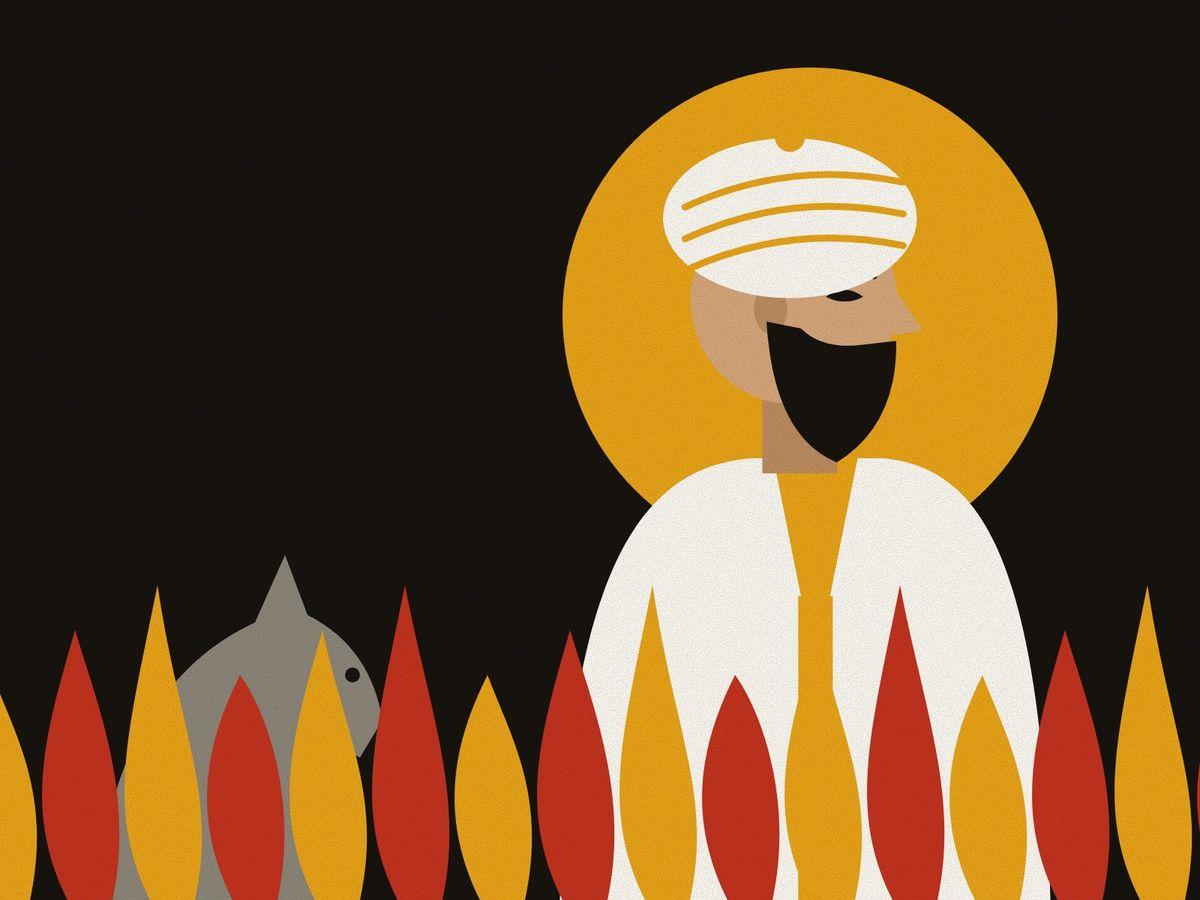
Siyavash and the trial by fire
The innocent prince who rode through fire to prove his honour, kept his word at the cost of his life, and was mourned for centuries in Central Asia.