The Shahnameh atlas · The heroic age · The reign of Kay Kavus
Siyavash and Sudabeh
سیاوش و سودابهA stepmother's desire, and a false charge against the prince who refuses her
Tus and Giv are hunting near the border of Turan when they find a beautiful girl alone in a wood. Her father came home drunk and drew his sword on her, she says, so she ran away. She is a granddaughter of Garsivaz, and on her father's side of the line of Fereydun. Each hero claims her, and they take their quarrel to Kay Kavus, who settles it by taking her himself. She bears him a son, whom Kavus names Siyavash. The astrologers read the child's stars and are troubled: they see that his fortune is asleep.
Rostam asks to bring the boy up, since no one at court can teach him as well. He takes Siyavash to Zabolestan and teaches him riding, archery and the lasso, hawking and the hunt, the ways of the feast and the court, justice, and the leading of armies. When the prince is grown he asks to show his father what he has learned, and Rostam brings him back in state. Kavus tests him for seven years, finds him noble in everything, and gives him a crown and the land of Kuhestan, which the poem says is now called Transoxiana. Soon afterwards Siyavash's mother dies.
Sudabeh
Then Sudabeh, the Shah's queen and daughter of the king of Hamavaran, sees Siyavash and falls in love with him. She persuades Kavus to send his son into the women's quarters to visit his sisters. Siyavash suspects a test and is reluctant, but he obeys. On his first visit she holds him too long and kisses his eyes and face, and he leaves her quickly for his sisters. On the second she parades her daughters and maids and offers him one of her daughters. Then she asks him to swear that when the Shah is gone he will keep her as dear as Kavus did, and she kisses him.
Siyavash blushes. He will not be faithless to his father, he thinks, nor make friends with Ahriman. But a cold answer might drive her to sorcery, so he answers softly: her daughter will be enough for him, and Sudabeh herself is like a mother to him.
On the third visit she drops all pretence. For seven years, she tells him, her love has made her weep blood. She offers him more than the king has given, and threatens to ruin his hopes of the throne if he refuses. Siyavash refuses. He will not throw away his head for desire, or betray his father. She seizes him, tears her clothes, claws her cheeks and screams. To the king she says that Siyavash tried to force her, and that she was carrying Kavus's child and nearly lost it.
Kavus smells his son's hands, chest and arms and finds none of the wine, musk and rose-water that scent Sudabeh. He knows the prince is innocent, but he cannot bring himself to punish her. He remembers how she stayed with him when he was a prisoner in Hamavaran, and he thinks of their children. He tells Siyavash to keep the matter quiet.
He knows the prince is innocent, but he cannot bring himself to punish her.
Sudabeh is not finished. A pregnant woman skilled in sorcery takes a drug and miscarries twins, and Sudabeh lays the dead babies on a golden tray as her own, killed by Siyavash. The astrologers say the infants are not the king's. The woman is found but will not confess, and Sudabeh weeps that everyone fears Siyavash. Kavus weeps with her and does not know whom to believe. At last the mobeds, the priests, give their advice: one of the two must pass through fire, for fire does not harm the innocent.
From the poemاز شاهنامه
Ferdowsi's words, with the English of Arthur and Edmond Warner's translation (1905–1925).
به رستم سپردش دل و دیده را
جهانجوی گرد پسندیده را
Entrusted little loath his heart and eyes —
This atheling, the child so loved by him —
To Rustam's charge,
نه من با پدر بیوفایی کنم
نه با اهرمن آشنایی کنم
I will not treat my sire disloyally,
Nor will I make a league with Ahriman.
کنون هفت سالست تا مهر من
همی خون چکاند بدین چهر من
And now for seven years this love of mine
Hath made my face to run with tears of blood.
In Mythologyاسطوره
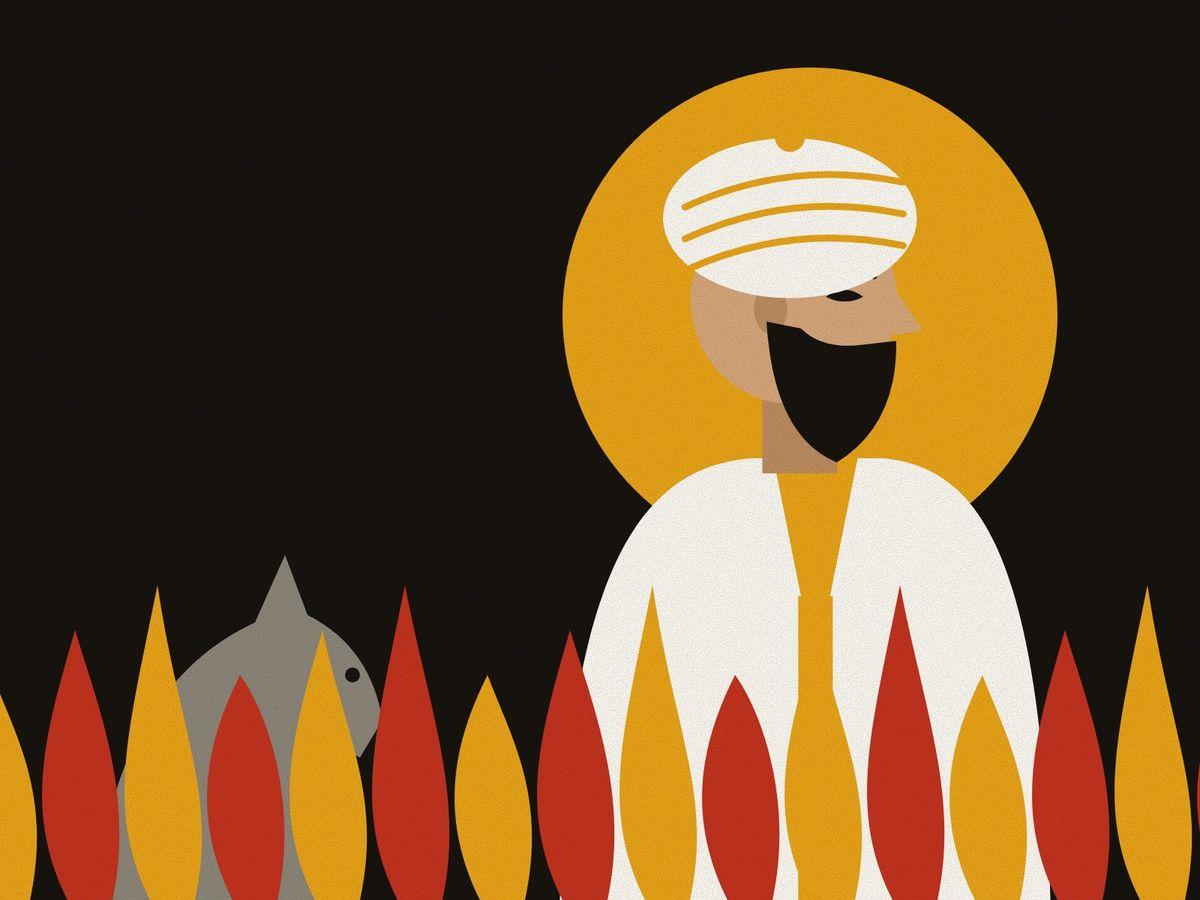
Siyavash and the trial by fire
The innocent prince who rode through fire to prove his honour, kept his word at the cost of his life, and was mourned for centuries in Central Asia.