The Shahnameh atlas · The heroic age · The reign of Kay Khosrow
Forud, son of Siyavash
داستان فرود سیاوشKay Khosrow's half-brother, killed on his own mountain by an army sent to avenge their father
Kay Khosrow gives the command of his first army against Turan to Tus, hands him his seal and gives him his orders. No farmer or craftsman is to be harmed on the march. And on no account is he to take the road by Kalat. There, the king explains, lives his half-brother Forud, son of Siyavash by Piran's daughter Jarireh: a young man of his own age, with troops of his own, who does not know a single Iranian by name. Take the desert road, he says; it is not wise to tangle with lions.
Tus agrees. But where the road divides, one way across a waterless desert and the other by Kalat and Charam, he chooses the green road and overrules Gudarz when the old man objects.
From his castle on Mount Sepad, Forud sees the dust. His mother tells him that the new king of Iran is his brother, and that his place is at the front of the war for their father. Ask for Bahram and for Zangeh, son of Shavaran, she says; they were your father's companions. Forud climbs a peak with the old retainer Tokhar, who names the banners as they pass below: the elephant of Tus, the sun of Fariborz, the wolf of Giv, the lion of Gudarz.
Tus sees two horsemen on the height and sends a rider to deal with them. Bahram, son of Gudarz, goes. When he hears the young man's name he asks to see the mark of Siyavash, and Forud bares his arm to show a dark mole, the sign of the line of Kay Qobad. Yes, he says, he is Forud, a shoot sprung from that fallen cypress. He offers to feast the army and to ride with it to avenge his father. Bahram warns him that Tus is headstrong, and that if anyone but Bahram comes up the mountain he should not trust him.
Tus will not listen. A Turk on a mountain, he says, like a black raven, is holding up his army. He sends his son-in-law Rivniz, and Forud's arrow pins his helmet to his head. He sends his own son Zarasp, and Forud shoots him through his mail into the saddle. Tus rides up himself, and Forud, on Tokhar's advice, kills the horse instead of the man; the commander walks back down with his shield on his neck while the women on the castle roof laugh. Giv's horse falls the same way. Bizhan, struck with his father's whip for mocking him, borrows a horse from Gostaham and climbs in Siyavash's own mail. His horse is shot too, but he goes on up on foot, and Forud reaches his gate just ahead of him.
The night of fire
That night Jarireh dreams that a fire rises from the castle and burns it and all its women. At dawn the mountain is full of spears. Forud fights until noon, until none of his riders is left, and as he turns for the castle Rohham and Bizhan close on him from above and below. His mace stuns Bizhan, but Rohham's sword cuts into his shoulder and Bizhan hamstrings his horse. He reaches his ivory throne and tells his women to throw themselves from the walls, so that none of them falls to Bizhan. Then he dies.
The women leap from the roof. Jarireh burns the treasure, kills the horses in their stable, lays her cheek on her son's face and stabs herself on his breast. When the Iranians break in, Bahram weeps: Forud has died more wretchedly than his father, for Siyavash at least did not see his mother killed beside him. The champions tell Tus that rashness bears the fruit of regret. Tus weeps for Forud and for his own son, and builds a royal tomb on the mountain top, where Forud is set on a golden throne with Rivniz and Zarasp beside him.
Forud dies on his ivory throne, and his mother dies on his breast.
The march goes on into snow, a night attack and defeat, and when Kay Khosrow hears of his brother's death he recalls Tus in disgrace. The poet has already given his verdict, after the first of Forud's arrows: a man's evil nature is its own reward.
From the poemاز شاهنامه
Ferdowsi's words, with the English of Arthur and Edmond Warner's translation (1905–1925).
گذر زی کلات ایچ گونه مکن
گر آن ره روی خام گردد سخن
Thou shalt on no account pass by Kalat,
For, if thou dost, things will go hard with thee.
بدو گفت کآری فرودم درست
ازان سرو افگنده شاخی برست
Yea, I am indeed Farud :
The fallen Cypress hath put forth a Shoot.
دو رخ را بروی پسر بر نهاد
شکم بردرید و برش جان بداد
And, having pressed her cheeks upon his face,
Ripped up herself and died upon his breast.
In Mythologyاسطوره
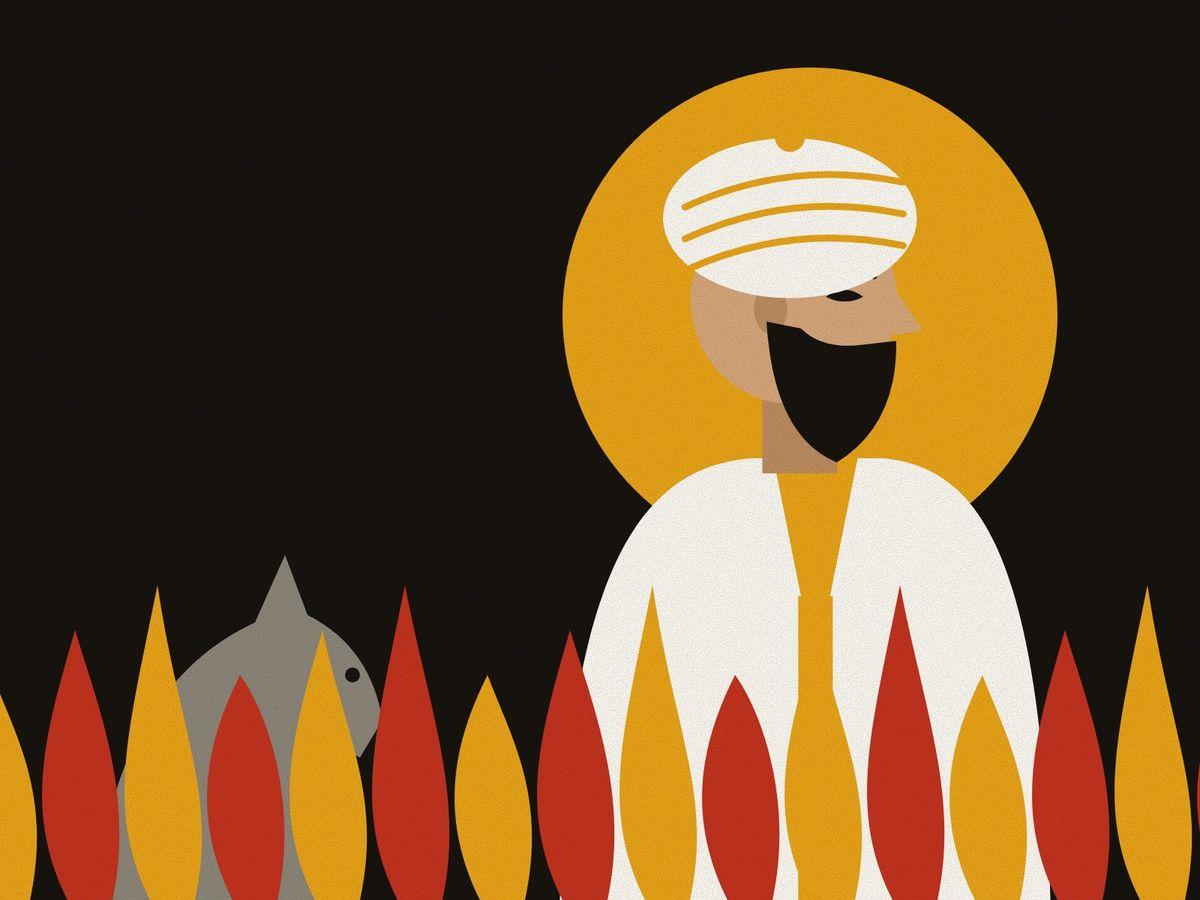
Siyavash and the trial by fire
The innocent prince who rode through fire to prove his honour, kept his word at the cost of his life, and was mourned for centuries in Central Asia.